Billy’s Bench: Addiction and Unexpected Community

“I’m going off the high dive, are you guys watching?”

My brother and I nodded vigorously as our uncle climbed the stairs to the highest diving board and waved to us from the top. He took his time, raising long arms into perfect formation above his head, bouncing a few times on the board before swan-diving into the greenish manmade lake below.

“That’s our uncle Billy!” we declared proudly as other kids looked on. We held our breath for what felt like hours waiting for him to emerge again and when he finally did, raced to the edge of the water to hug his legs. He was so much fun.
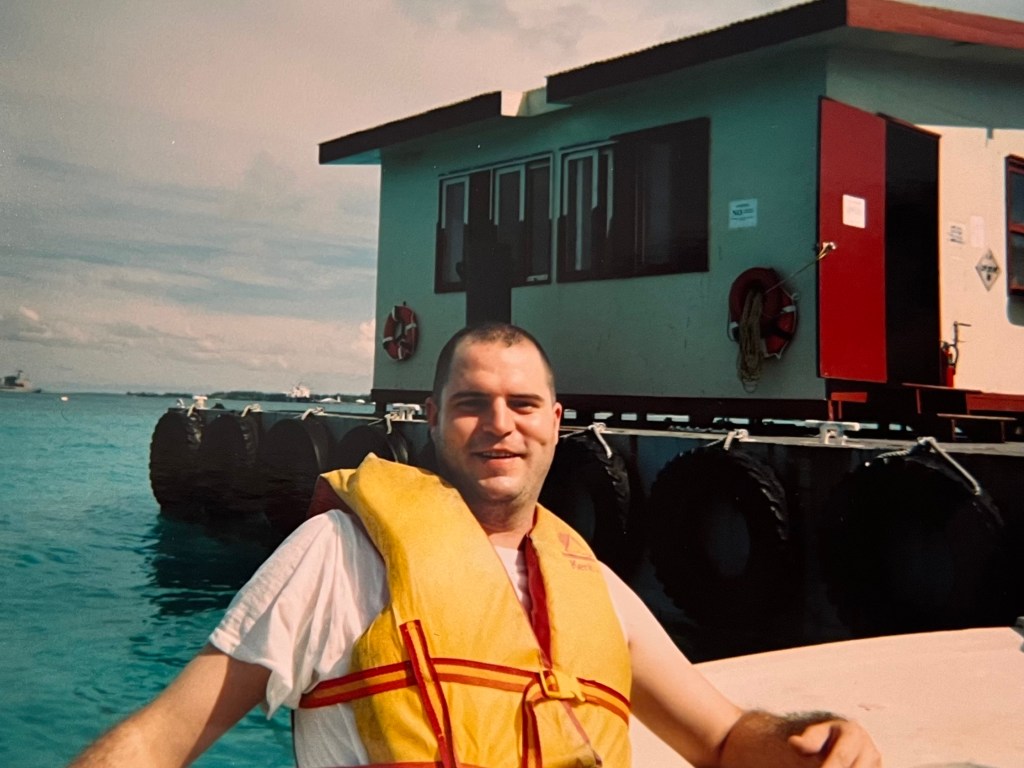
Billy could move fluidly from the realm of adults to the realm of children—it seemed he didn’t belong neatly in either world. I remember watching Nickelodeon together splayed out on my grandparents’ 1970s chocolate brown shag carpet, laughing as Keenan and Kel bantered on the television. Despite being six foot three he could immediately get on our level.

I didn’t know about alcoholism back then or the way it snakes through generations—my great-grandfather on my mom’s side had also been an alcoholic. I didn’t know Billy had first tasted beer at 11, started struggling with drinking at 14 and was trying to escape the bottle ever since. If he knew how deep the dependency went at the time, he didn’t show it.

In the decades since that day at the pool, Billy moved across the world, from Long Island to the South Pacific to Spain and back again. His final stop was an apartment just 10 blocks from mine in Manhattan. I remember his excitement at being neighbors and his joy with setting up his own place.

But in the 700-plus days he lived in my neighborhood I only saw him twice.

***

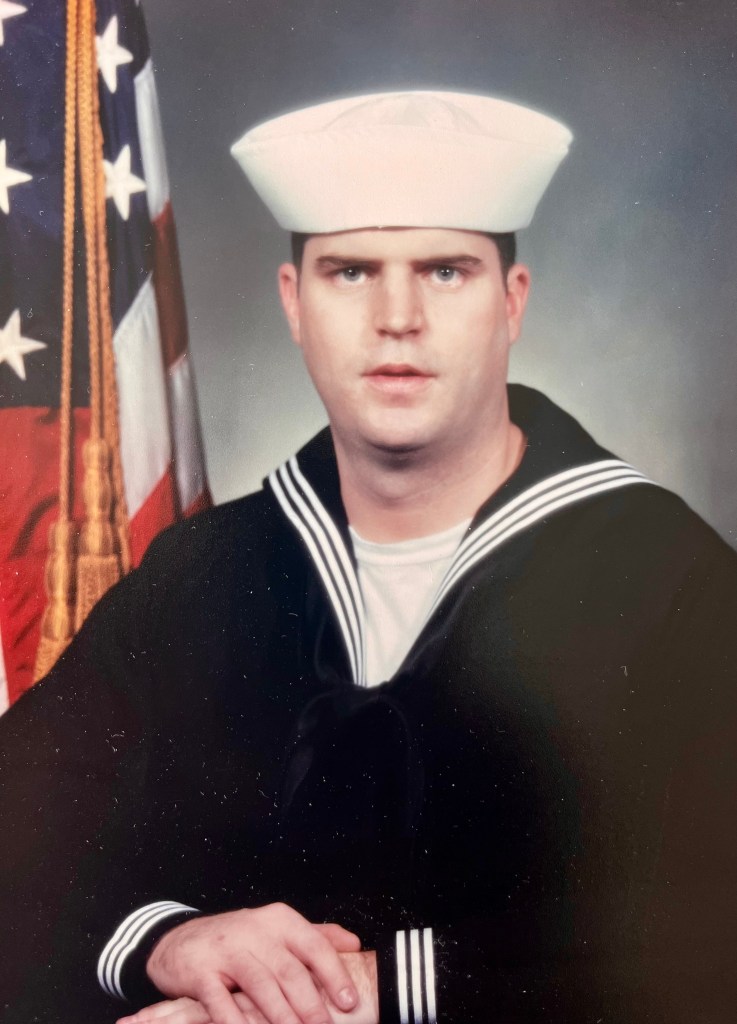
When I was about ten years old, a new photo of Billy in a Navy uniform appeared suddenly in our living room. He looked handsome and healthy, but his serious expression was nothing like that of the fun-loving uncle I remembered. I later found out Billy’s drinking had worsened around that time and my grandmother wanted him out of the house. That’s how the phase of his life in the Navy began.

My memories of Billy during those years are choppy, like a file cabinet filled with scattered, torn documents. After training he’d been sent to Diego Garcia, a remote island in the Indian Ocean that had been a refueling station for the Middle East in the wake of 9/11. Off in Diego Garcia, there wasn’t much else to do other than drink. I imagined it then as a paradise; I imagine it today more like a prison.
Following Diego Garcia, he was stationed in Spain, where he met a lovely woman and had a daughter. But his drinking continued, complicating his relationship with both. To stay physically close to his daughter who he loved dearly, he lived for many years in the south of Spain, where he had a small apartment to go home to at night but often appeared homeless, spending most days on the streets. He’d occasionally get sober and find a job, but it was never long before the drinking pulled him under yet again, powerful as the ocean.  

Billy described his last few years in Spain as “surreal” and “Kafkaesque.” He was beaten, robbed and propositioned. The drinking ravaged his body. He went from being six feet tall, broad-shouldered, and healthy to thin, graying, and hunched, his feet slowly losing feeling from the neuropathy.

My mom was ten years older than Billy, and from the time he was a child she looked after him, like another parent. They shared an extraordinary bond, and no matter where Billy was in the world, he was never far from her thoughts.

One weekend my mom texted him to check in. He replied, “Doing bad, but I try to give civil compliments on the street to civil people.”

That was a constant with Billy: wherever he was in the world, he found community. People didn’t see an alcoholic on the street; they saw a kind, intelligent, funny, and deeply caring man who’d been dealt a hard hand in life.

Still, Billy’s internal organs were rapidly shutting down, which no amount of kindness or friendship could stop. Pancreatitis, gastritis, chronic double vision, rotten teeth, hypotension, broken shoulder, chronic rib fractures—the list kept going. His landlord would find him each night to fireman-carry him home.

In March 2018, my family decided they needed to go to Spain to rescue him once and for all. He didn’t want the help, but clearly only had a few weeks to live without an intervention. “Billy had been struggling and was literally near death but never wanted to be a burden,” my mom remembers.

My dad and uncle Pat flew to Spain to lead the rescue mission. My dad remembers spotting Billy sitting in front of a church, messy, dirty, and unshaven. As he approached, people came out of shops one by one because they realized the Americans were there to take Billy home.

Just before my dad and uncle stepped away, two nicely dressed women from a fancy boutique near his “spot” came out to hug Billy good-bye. To them, his filth didn’t matter. This was their friend.  

***

Even when Billy was back stateside and living nearby, he’d again shifted to another world, one I couldn’t quite access. I’d sporadically get tough-to-decipher texts from numbers I didn’t recognize. Sometimes he wouldn’t answer back, and I guessed he’d lost his phone again, or had been borrowing one from a stranger. I often thought of him but was also scared of running into him because the Billy I knew was bright and sunny. I had never seen him during a bender and didn’t want to. 

Our lives only intersected a few times when he lost his keys because I kept a spare. I remember one afternoon he met me outside my apartment to get the key, his beard overgrown, clothes rumpled, carrying a ripped plastic takeout bag stuffed with personal belongings. I tried not to feel embarrassed, but my discomfort lingered. I could sense my doorman watching.
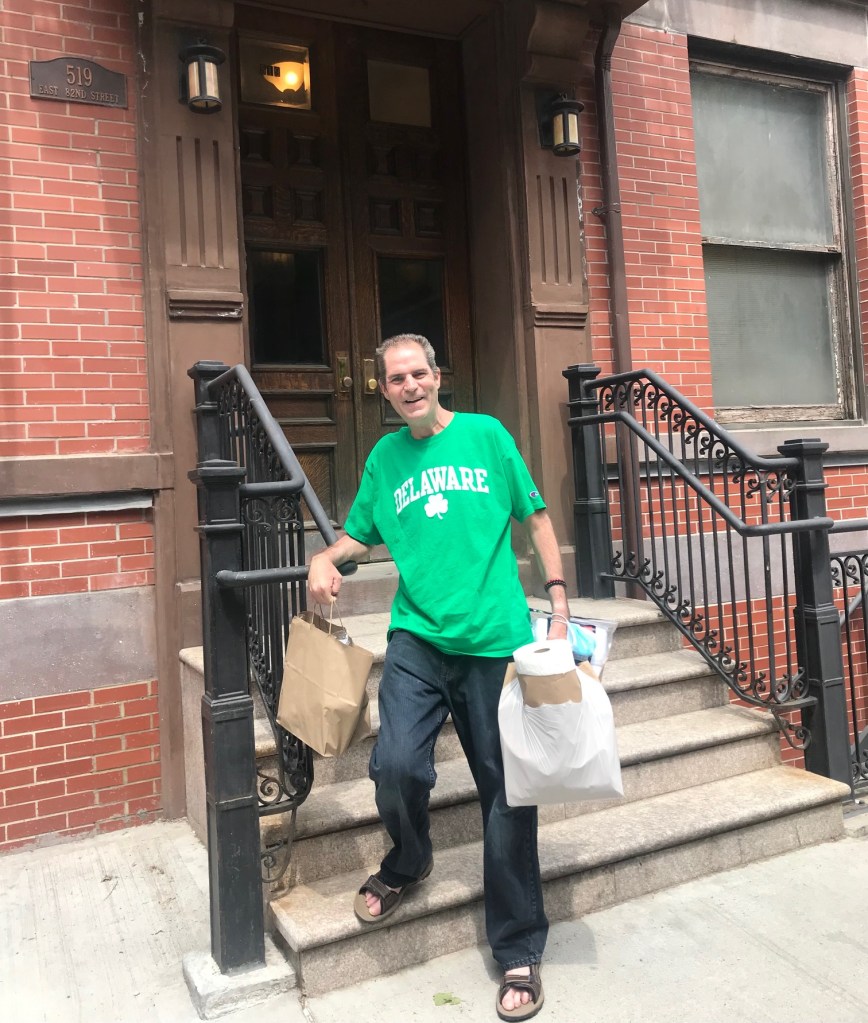
“This is my uncle,” I wanted to explain. “This isn’t a random guy approaching me on the street.” But the words stayed trapped inside me. It felt like we were two balloons that if released, would immediately drift in different directions.

When my uncle died in the summer of 2023, I was 3,000 miles away in Lisbon, Portugal. I’d spent most of July reading on park benches and my uncle’s declining health had only been on the fringes of my mind. He’d survived the brink of death so many times, I thought he might be invincible. But all the drinking-induced ailments had finally caught up to him.

He was 51 years old.

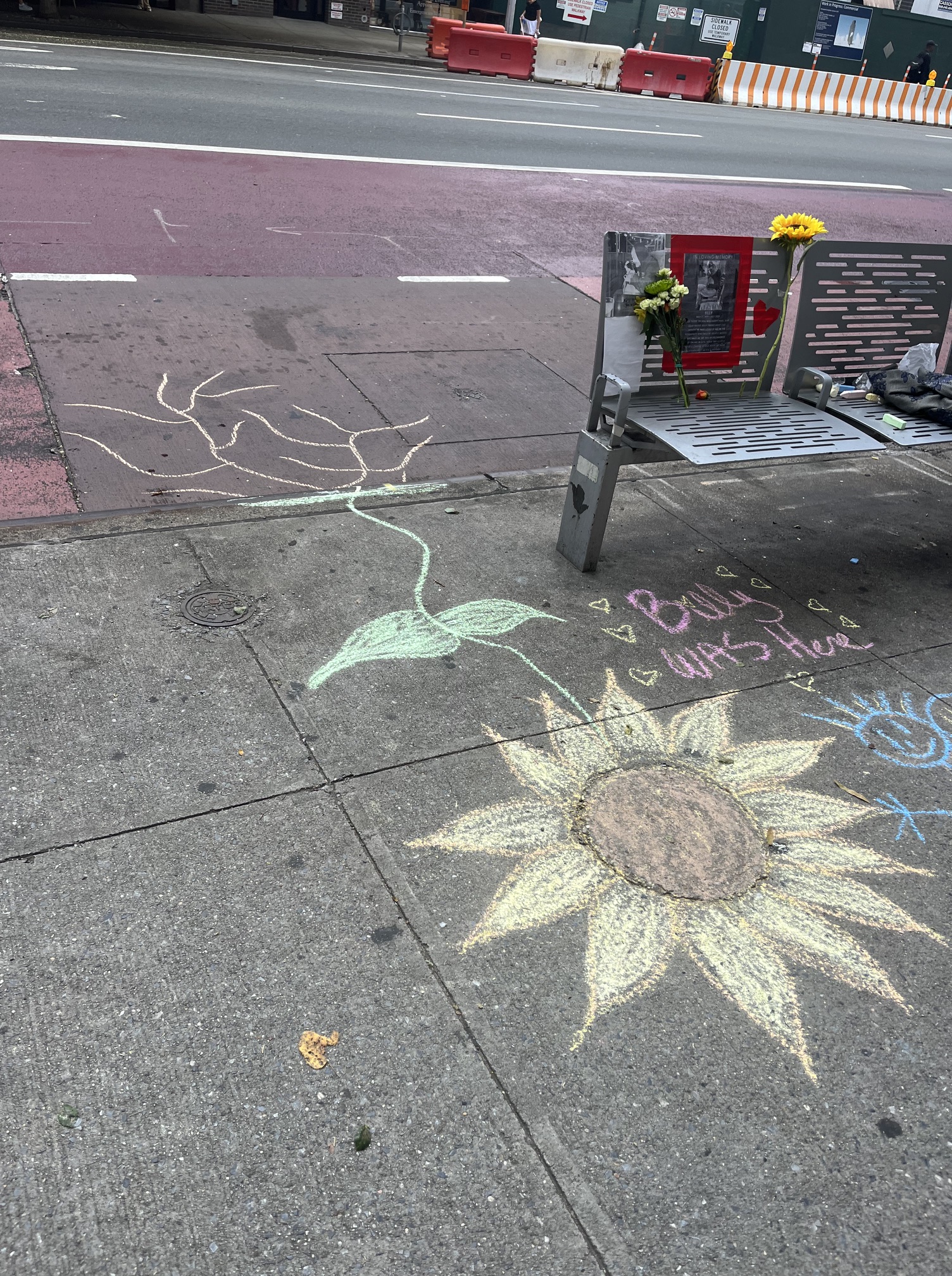
Only after Billy passed did I realize he’d spent the last two years of his life on a city bench just 10 blocks from where I lived. Billy never told me he spent his days there; I never asked. His friend Howard, who’d attended a local temple and had gotten to know Billy over the years, reached out to my mom when he saw remembrances posted on “Billy’s” bench.

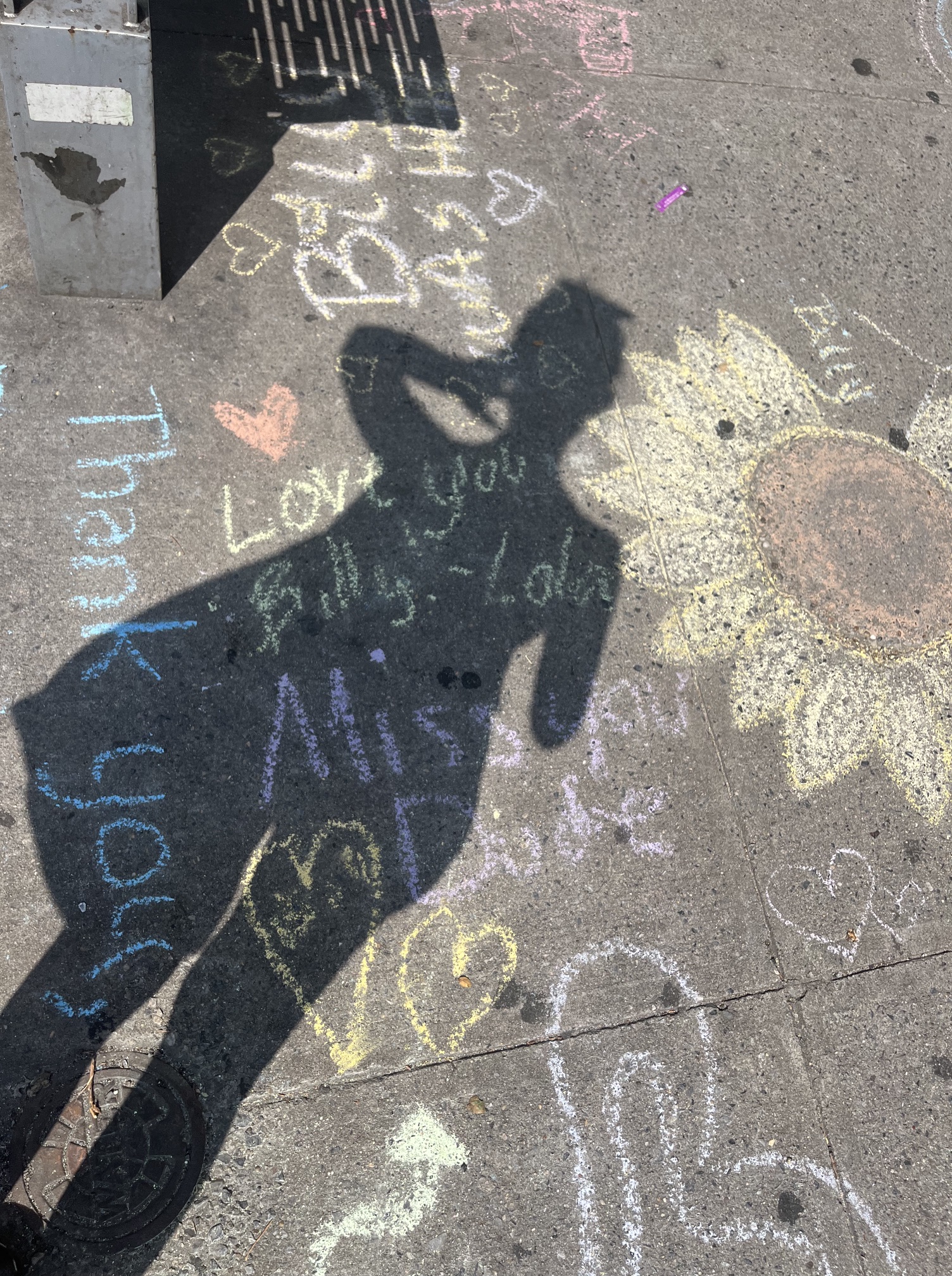
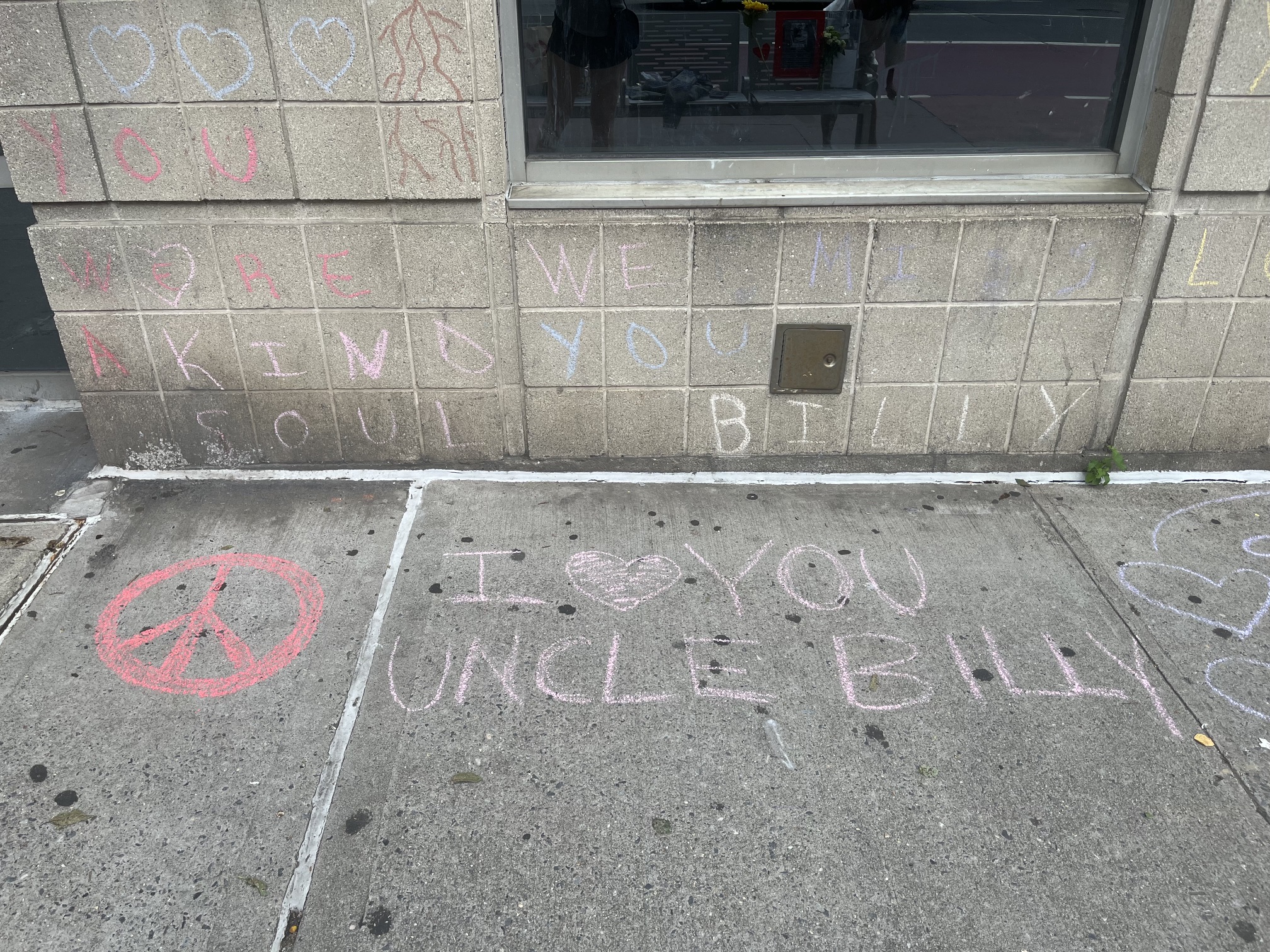
So when I arrived home from Lisbon I wandered the 10 blocks down, hoping to feel close to him. I saw chalk memorials expanding across the sidewalk and even up the side of a building, like nature reclaiming the land.

Every few minutes someone would stop, ask about Billy, express their sorrow. I thought the first few times were a coincidence, but I ended up speaking with 20 people in an hour that evening who all had different stories to tell about Billy and what he meant to them. It showed me not only Billy’s kind spirit, but the loneliness so many people face, even those who on the surface have everything you’d want in life—a job, a family, a safe place to live.

That day I met a wonderful woman named Jessica who explained she’d been close friends with Billy. She drew a sunflower on the sidewalk, undeterred by the fact that it was washed away each night.
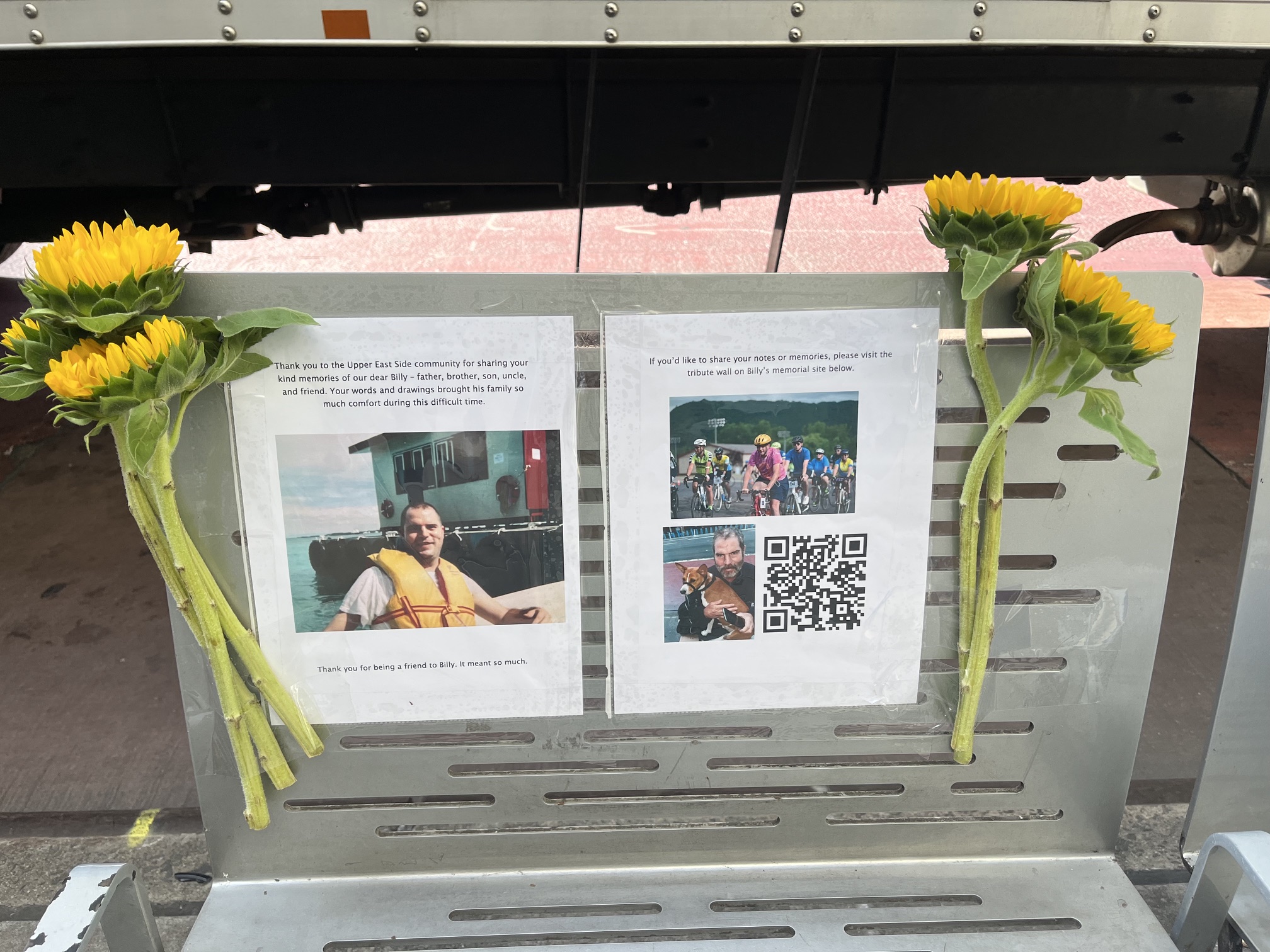
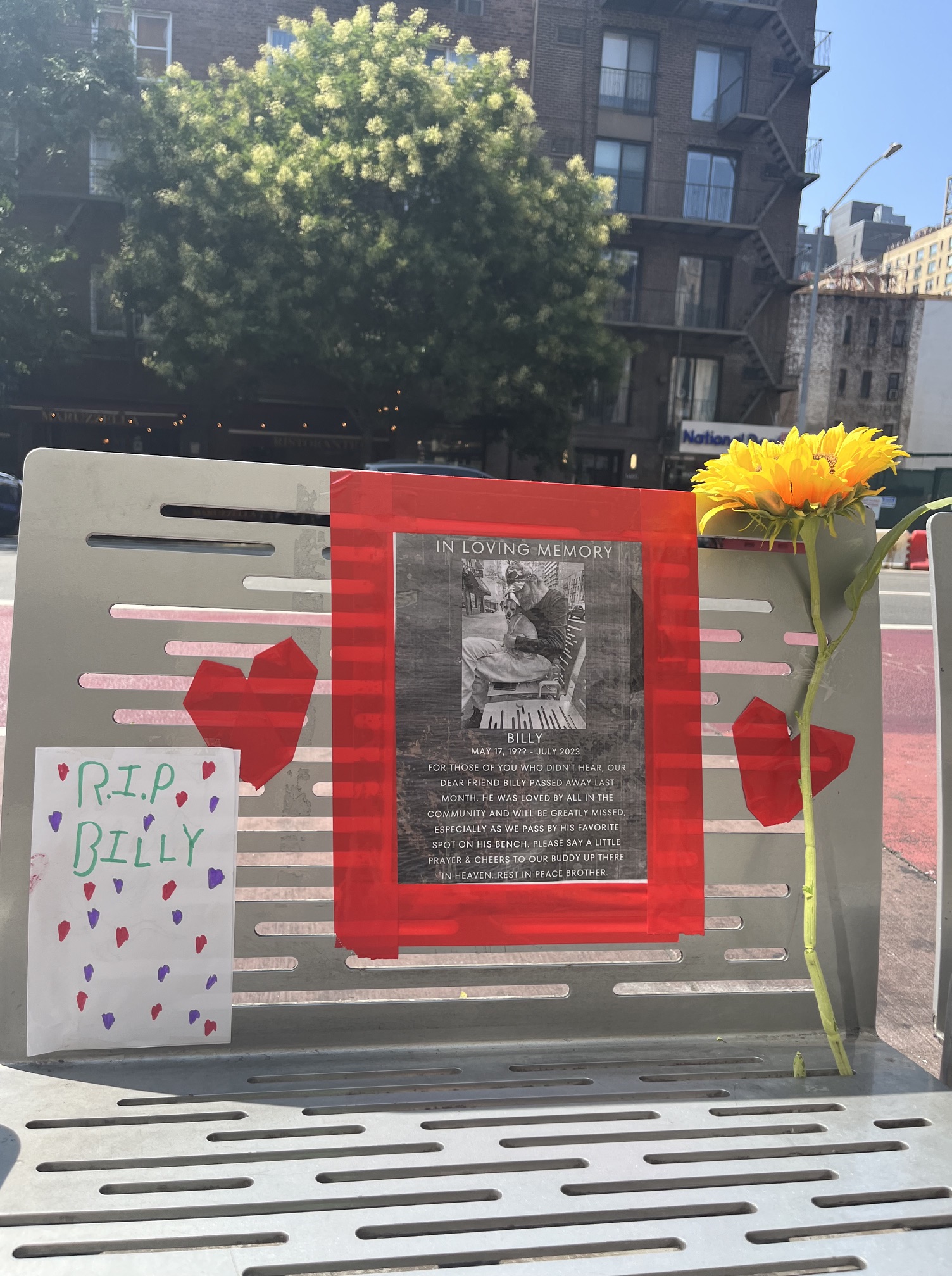
A few days later I pasted a QR code on the bench to his memorial site and watched in awe as message after message appeared from Upper East Side acquaintances. These were people from all walks of life. Parents. A grandmother visiting. Young professionals who had just moved to the city. All of them leaving their interactions with Billy in better spirits.

“You left a big hole in the neighborhood after you left us Billy,” Mike wrote. “I hope that you can see from the other side how many people in the neighborhood care.”

 “I would see Billy every morning on 77th street getting coffee and we would chat briefly,” Laura remembered. “He always helped me get my day started with positive energy.”

 “He was so kind to each of us, but especially to our children,” wrote Rod and Charlie. “I recall Billy’s excitement when the kids showed off their medals won at the martial arts tournament.”

All of these people in the Upper East Side saw Billy for who he was. They knew about his love of dogs, the Giants, and his close relationship with my mom. And yet, at the same time he’d built these friendships with strangers, he’d disappeared from his family. I felt deeply guilty for not reaching out to him those last few years, but also hurt he hadn’t reached out to me, as if these new friends were more important. I wonder if it just became too hard to face us, those of us who’d witnessed his long struggle.

Occasionally I’ll sit on Billy’s bench for a few minutes, pushing away the empty Dunkin’ bags and debris, and try to see the world from his perspective. The city shuffles around me almost as if he were never here, but I know his memory is now seeded in hundreds of New Yorkers, and his stories will sprout again and again. As people rush by, I can see all the versions of Billy—the diving, the laughing, the silly, the sick, the young, the weathered—passing right in front of me.

I’m comforted knowing I loved them all.

The First Time We Met

By Sara Felsenstein

Author’s Note: This is the first of a two-part fiction exercise to expand  the phrase, “The first time I met…. The second time I met…. The last time I met…” into a story.

THE FIRST TIME WE MET was  at the manmade lake up in the Catskills next to Martin’s General Store when we were both twelve. I was living for the summer at the Monticello Bungalow colony with my parents and older brother. You were staying somewhere across the dirt road with your grandparents. I knew that because everyone who lived across that dirt road was a grandparent or just really old, sitting all day in a large circle on weak, folding rainbow lawn chairs yapping yapping yapping yapping. You were the only kid over there and had too much life for that.

The first time we met though was at the manmade lake about two miles down where the sand was a strange medium-brown color and the grains were slightly too large and got caught between your toes, staying there for days. My friend Deborah said it was imported from Hawaii but my mom said it was syn-thetic. One afternoon we were both at the 10-foot cement dock at the center of the lake and you were doing these fancy dives. How do you do that? I asked but you were already in the water. I stood in the center of the dock and watched you, over and over, plunge into the water and then emerge, squinting your eyes and slicking back the dark hair off of your face.  It was sixty degrees and too cold for swimming so every time I came out of the water my skin erupted in goosebumps, and my bathing suit, a size too large, hung from my shoulders like loose skin. You thought that was funny and pointed and laughed. You were not cold. I only did cannonballs. You only did dives and backflips. That was all I knew how to do, cannonballs, but my 100 pounds didn’t make much of a splash, although I tried, I really tried. Let’s dive, you said, it’s more fun. But I can’t, I said. Are you a scaredy cat na na na na you said. I hated being called a scaredy cat by my big brother so I hated it even more from you. You grabbed my hand and said come on let’s jump off together. Your hand was so warm and I got distracted thinking about it but you had already jumped and I didn’t jump in time so the edge of my leg scraped against the edge of the dock as I fell into the water. I fumbled around in the water and found the rickety metal ladder and yanked myself up and tried not to cry. A few tears escaped my eyes but it could have been lake water, for all you knew. On the cement dock I bled maroonish blood and the blood dripped into the green opaque water but didn’t change its color. You took my hand and said let’s go get you fixed up. My knee stung all the way back to shore. It was my fault. You felt bad, real bad though. By the time we got back to shore all the blood had washed away and the cut was hardly noticeable, except a grain of sand was caught beneath the flap of skin and stung, it really stung. Your grandmother wrapped a white towel around my leg and pressed it against my cut until my leg was numb with tenderness and you mouthed I’m sorry.

 THE SECOND TIME WE MET was at an outdoor hoedown on the Delaware River near a whitewater rafting site. I was 19 and camping out with my girlfriends and we all expected to talk more about boys that night than actually be with them. Most of the boys we came across were young ones on Boy Scout trips, or older men with receding hairlines who sat around the campfire with a beer just talking about their glory days. There were a few young and attractive ones, though. We called the hot guys “chipmunks.” The ugly guys we called “squirrels.” It was our immature code and to this day I have no idea how we came up with it. The whitewater rafting site that was hosting the hoedown brought in this bad cover band that played on a makeshift wooden stage. My friends and I, we passed around the metal flask filled with whiskey that I found in my parents’ basement. The whiskey stung our throats but the river air was the best chaser. The band was playing Maroon 5 — I thought this was a hoedown — and I turned around and saw you and you were shirtless with dirt streaked across your chest. I was wearing faded jeans that were too tight at the thigh and an inch too short at the ankles. My T-shirt was tied in a knot above my belly button and I was much less drunk than I let on but I felt sexy. You were wearing jeans and your dark hair was matted down from the relentlessly humid August air. You were sweaty and tall and it was a turn on, I almost forgot I already knew you. You came up to me and said hi and reminded me of how we met the first time, seven years ago, out here in manmade nature. My girlfriends gave me looks go go go so I let you take my hand and spin me around to the rhythm of whatever song was playing at the time, there was nothing to lose. I loved the way bits of light caught in the branches of the forest trees and then slowly, like rain, dripped from them and got all tangled all in your brown hair.  For a brief moment you pressed up against me; the sweat glued my jeans to my legs and the denim became my skin.

THE LAST TIME WE MET was many years later when you were bagging my groceries at Walmart. It was back in Monticello. Your grandparents were long dead and had given you the old gray bungalow, that’s what I heard from the people in town. Your hair was thinning and graying on the sides. The nametag said your name so I knew it was you. There could be a thousand yous but this one was you. My credit card said my name so I knew you knew.  I felt self-conscious and tried to smile. The stubble hid your half-smile but the shame contorted your face in ways I wished I had never seen. I wanted to say hi, hello, how are you, but none of those words escaped my mouth. You probably didn’t know I was alone. The truth was, you didn’t know me. All I could muster was “thank you very much.” I didn’t even say your name. You didn’t even nod. I pushed my cart past you and almost to the sliding doors, then turned back to get one last glimpse. I half-expected you to turn and look at me, at the very same time, like the movies, to glance and wonder and think back to the past, but you never did, you just continued like you were, bagging endlessly, your silent voice swept away in the sound of beeps and printing receipts.

A Fiction Writer’s Manifesto

Photo by Enoch Wu

Fiction is both a personal form of expression and way of commenting on events that affect the population at large. Fiction should strive for beauty because it can — so many other forms of writing do not offer that freedom. My fiction writing is not rebellious nor is it experimental but it is definitely influenced by the fast-paced writing forms of the online world.

My work makes use of two opposing writing styles and constantly displays a tension between them: the succinct phrases characteristic of journalistic writing and the metaphoric imagery characteristic of poetry. I like to approach fiction methodically — as I would in journalism, but with feeling — as I would in poetry. My fiction is based off these two types of writing, yet falls somewhere in between them.

When composing fiction, I strive for five main characteristics:

  1. The beauty of the written word: Fiction is an art form, so I want my words to sound beautiful, regardless of the subject matter. Using words with a history of alternate meanings — and being conscious of those alternate meanings — can help deepen the implications of a story. Words in fiction should sound beautiful together despite the content or subject matter. However, the definition of “beautiful” can vary depending on the story. That being said, images should not be beautiful simply for the sake of being beautiful; they should also play a larger role in the storyline.
  2. Economy of language: This characteristic fits hand in hand with the previous one. I believe simplicity of language adds to a story’s beauty — the simpler something is conveyed, the more emotionally resonant it is. Portraying beautiful images in minimal words is extremely difficult to do, and is a great accomplishment when it is achieved.
  3. Engagement in current events: I tend to write fiction that is, naturally, influenced by the events going on around me. I also intentionally create fiction that comments in some way on a relevant societal issue. I’m careful to make that issue a central motif without explicitly stating it. Building up the tension of a problem without outwardly addressing it creates a foreboding tone; not saying something outright can make its presence in fiction even stronger.
  4. Focus on realism: I almost always write in the realist style. I’m not comfortable writing in genres like fantasy or scientific fiction, but those genres also aren’t conducive to the goal I have to shed light on issues that might be otherwise brushed over. My stories tend to begin quite ominously but in familiar and typically comfortable settings — I want the reader to feel uncomfortable from the beginning without knowing why. Then, slowly, small details are dropped so that discomfort deepens. Through a focus on realism, I try to address topics that might be painful or taboo in casual conversation.
  5. Multiple narrative planes: I envision my writing as moving in several directions at once, all convening somehow in the ending. My goal is to set up these different narrative planes early on in the text, but write with enough authority that the reader is convinced each has its own purpose. Sometimes these layers are created by integrating different kinds of writing, including poetry, journalism and essays, into the fiction itself. The various layers also help create endings that are somewhat ambiguous but still convey a specific feeling.

My writing is generally traditional. I love writing in the vignette style in particular because it allows me to incorporate poetic phrases naturally into fiction. Vignettes give me the opportunity both to create the beauty that I strive for and to comment on a single issue from a number of different perspectives.

As a young writer, social media and online writing inevitably influence my work, since those are things I engage with on a daily basis. Despite most forms of writing being in a state of such rapid change, however, I believe traditional, printed fiction continues to be crucial today. The mind processes ideas differently when work is read on the printed page versus when it is read on a screen, so the printed page is necessary even as the world of digitally published fiction expands. A goal for my future work is to reconcile these two sides of fiction, always keeping in mind how a story will be interpreted differently depending on whether it’s displayed on a digital or traditional background.

622 Jefferson Street

Below I’ve posted the first three sections of one of my short stories, “622 Jefferson Street.” I wrote it as my final assignment for an Advanced Fiction Writing class at Notre Dame this past spring semester, but I’ve been working on it in one form or another for about a year. The tone, style and even plot line are still in flux, but I’ve given myself a few months’ distance. I’d appreciate any comments you might have– positive or critical! And please contact me if you’re interested in reading the full manuscript.

***

622 Jefferson Street

The 1200 block of Jefferson Street surprised me. It’s hard to tell what a neighborhood’s like from the aerial view on Google Maps, but when I got there I couldn’t believe how beautiful the houses were. Old Victorians with extravagant molding, long windows and the sad remnants of wraparound porches. Somehow, the houses looked vaguely familiar, but I’d never been to Ohio before and I’d definitely never been here.

The houses were beautiful but twenty years past their prime, stripped of paint and porches, roofs so thin a bird’s claw could puncture them. If you looked close enough you could see entire structures sinking an inch or two into the dry earth, the ground coughing up bits of dust from the pressure.

If you looked even closer you could see folding lawn chairs — the old rattling kind made of rainbow vinyl and plastic — and on those lawn chairs, people. The people only watched what was in front of them. The people stared right into the dusk, their eyes dark and full and steady.

I pulled up slowly, grazing the curb. When I got out, a bunch of teenagers were messing around in the street, cursing and kicking around empty cans of Coke. I walked briskly past them. They stared at me but said nothing; I became intensely aware of the way my skirt’s material gathered under my ass each time I took a step. The can rolled towards me in slow motion and I kicked it to the side with my heel. I didn’t look back. I loved the way that skirt hugged my curves but 1208 Jefferson Street was no home for pencil skirts.

The empty tin sound of the can-kicking didn’t resume until I’d made it two blocks down.

I had gotten the call around 5:30 p.m. to head out to the East side of the city. Fifth fire in two days, Shirley said. Still burning so I better move fast. Fast fast fast fast, I know you’re on the late shift and it doesn’t start till six but it’s red hot and will be out soon, we need a photo Jules, the photog couldn’t get out there — his kid’s sick with the stomach bug — so we’ll need you to take a shot on your phone. You’ve got one of those smarty-pants phones, right? Always better to capture something in action than post-action, right Jules? I mean, who wants to see a burnt-down house, a pile of ashes, when you can see a burning one?

Shirley advised me to park way back on the road away from the cop cars, which meant I would have to walk through the neighborhood. Jeez, this wasn’t one of the best neighborhoods — she should have warned me. That’s the thing about Shirley, I love her but she’s been off the streets so long she doesn’t know how bad it’s gotten around here. Considering there’ve been 17 shootings this summer and 13 in August alone, she should realize. But Shirley, she just remembers when she was the cops reporter back in the eighties and the bad part of the city was a quarter square mile thick with bodies and blood, all of it gang violence. As long as you stayed away from that you were safe.

But it’s not like that anymore. Things around here are always smoking, or burning, or disappearing altogether. The violence goes wherever the heat goes and the heat is everywhere. And Google Maps doesn’t tell you where the “good” and “bad” neighborhoods are in Norge. Google knows, I’m sure, but Google has to be objective. Google has to be PC.

I had one more block to go until the fire. The house looked totally fine from a distance, which was the strangest part. All of the damage must have been shrouded in smoke.

At the end of the road I saw police lights, flashing violently behind a shade of ash and smoke. The closer I got, the lights became stronger and the fire weaker.

I felt around my purse for my notebook and tucked it under my arm.

I couldn’t help but view the scene as swarming dots of darkness and color.

***

 “It will get easier, don’t worry, Jules,” Shirley told me that night after I came in from the Jefferson Street house fire, my hair disheveled and reporter’s notebook essentially illegible. Soaking wet. It looked like I’d fallen right into the hose’s stream, and I hoped that’s what Shirley thought, but honestly, my water bottle just opened in my bag. God damnit.

I’d already lost three iPhones that way and I really needed to stop doing that.

“After awhile, you’ll hardly think twice about the fires,” Shirley said.

I nodded at my editor without really looking at her, and when she walked away took an excessively large bite from my cardboard vending machine sandwich. The turkey was about an inch think, a slab of salt and rubber. The bread was hard. Probably sitting in there since the 70s when they installed the vending machine. I was absolutely famished, though, with that clawing gurgliness in my stomach, so I ate it anyway.

“You’re a brave soul,” the court reporter, Kelly, said to me as she walked past my desk. I looked up to smile at her but my mouth was stuffed with bread and meat. I tried to do that thing where you smile with your eyes, but because my mouth was all contorted with sandwich, I’m pretty sure it just looked creepy. So much for making good impressions on your coworkers. She sort of stood there awkwardly, waiting for my response as I tried desperately to swallow, but the bread was just too dry to slide down that easily. Not my fault, but how do you tell someone that?

Finally, I managed to get some words out.

“Um, thanks Kelly. I really appreciate it.”

It was my first fire, my first real one anyway, and I was glad I was getting some recognition.

“Even if I were actually starved, like actually starved, I wouldn’t buy one of those sandwiches,” she said. “That’s intense, Jules.”

***

For a few days I didn’t think much about the Jefferson Street house fire. The Norge Daily News kept me busy running around to drownings and shootings across the city, picking up reports from the station downtown.

I didn’t dwell on it much, but it seemed everyone else did. The people in Norge were scared, more so than ever, and they definitely had a right to be. I could see it in the way they stood — the broad-shouldered men in circles crushing beer cans in their hands and the cowering women, huddled together on the edges of their lawns. It was only mid-August, and already 20 shootings had happened in the city. Most of it gang violence, of course, but not all. And the drive-by shootings were the most frightening. One man was shot to death at night on his way out of McDonald’s, only one bite out of his 99-cent burger, still hot and fresh in his hand.

How do you stand all the death?  My mom, an accountant where I grew up in suburban Boston, asked me one afternoon while I Skyped her at a picnic table during lunch. But the truth was, I didn’t always mind it. There was job life and there was life life. And shootings don’t always mean death, of course, there were only three homicides of those 20 shootings. Covering violence is exciting, horrible to say but it’s true. And there’s a certain distance a police reporter has to have, kind of like a doctor doing major surgery, who knows his patient might not survive — you can’t be attached to everyone you get to know.

Writer’s Block

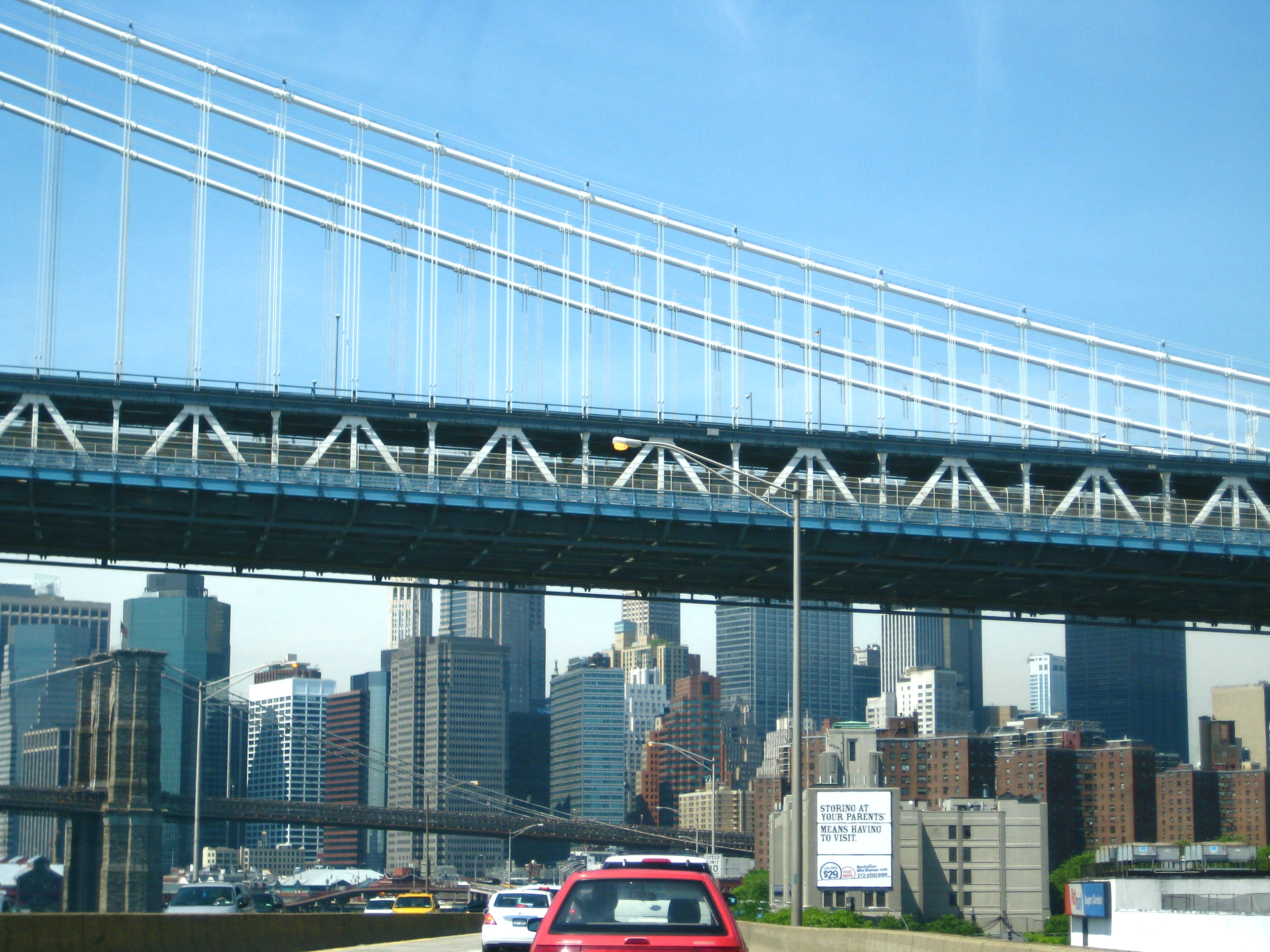
Taken on FDR Drive on my way to Brooklyn!

Like I said, lately I’ve been thinking a lot about my next longer piece of fiction. This is always the hardest part, coming up with an idea. “It’s not about what you write– it’s how you write it” might be a writer’s anthem, but still, there’s definitely merit in writing that presents a fresh, new idea.

How do you make an old story fresh, or a new story relatable? How do you avoid writing what hundreds of people have already written?

One thing I know for sure is that I want to write in the vignette style. Some of my favorite works of fiction are written this way– Jhumpa Lahiri’s Interpreter of Maladies and Sandra Cisneros’s The House on Mango Street. I love how vignettes allow for multiple perspectives on a common theme, and let the writer flip through time effortlessly. There’s also something poetic about a series of vignettes, because each one is pretty brief. Sometimes a never-ending chunk of text, no matter how amazing the writing, is exhausting. Vignettes let the reader and writer breathe.

I’m a fan.

But what to write about?

Right now I’m at that stage when ideas are still forming; for a moment they’re immensely exciting and I can’t wait to put pen to paper. Then the feeling fades. What was I thinking?  I can’t write about that. Whoosh. Off to the trash.

When I was younger, I always saw fiction as a total escape from my  suburban life, a chance to travel outside the bubble. I wrote about things I had no experience with: flappers from the 1920s, a drug-abusing mother, children with mental disabilities, a quirky New York City coffee shop. I want my new work to fall closer to home. I’ve found that good fiction writing always involves opening up somewhat. Fiction doesn’t have to be based on your life, but on some level it has to be based on your experiences.

Much of my family history lies in Brooklyn, N.Y. My grandfather (mother’s father) grew up in an Irish tenement in Brooklyn in the 1930s and 40s. My father grew up in Brooklyn Heights in a Jewish neighborhood in the 50s and 60s. People usually think of Brooklyn through its context with Manhattan, but for those who grow up there, Brooklyn is its own entity, harboring a history and character independent of “The City.”

When I think of Brooklyn I think of rising housing prices, veganism, the Brooklyn Bridge, trendy bars, artists’ studios, and hipsters. The Brooklyn I see is totally different from my father and grandfather’s Brooklyns. My story would be set only partly in Brooklyn, and would not be focused on history, but it would be interesting to somehow show the area’s development through the lense of a modern-day 20-something-year-old.

Sparknotes of a book that’s not written:

Vignettes/Flashbacks. Brooklyn. Manhattan. Midwest. Social Networking. Newspapers. 9/11.

I’ll elaborate on the other themes in a later post. Vague, I know, but let’s see where this takes me…