A low-key Sunday birthday

I love Sunday mornings.

But they’re even better when it’s your birthday.

irvingfarm

On Sunday I woke up on the early side and spent the morning doing one of my favorite things: relaxing at a coffee shop. I’d been meaning for awhile to check out Irving Farm Coffee Roasters in the Upper West Side, a spot my roommate had recommended but I’d been reluctant to go to since they don’t have wifi.

But today was my birthday. Who needs work? Who needs wifi?

I took the 1 train uptown and the shop was just around the corner from the 79th Street stop. I could tell immediately it was popular from the line out the door. Irving Farm bustled with Upper West Siders getting their pre and post workout coffee fixes, young families gathering for quick breakfasts before church, and older couples quietly reading The New York Times.

I waited on line for nearly 15 minutes just to order coffee, something I typically wouldn’t have patience for–but time is one of the great luxuries of Sunday mornings.

And I have to say, the quality of the coffee and the ample seating space made it worth it.

They also serve all their cold drinks in mason jars (don’t ask me why but that’s a game changer).

coffee

After getting my dark roast I grabbed a seat in the back corner, opened my notebook, and did some writing. Irving Farm’s lively atmosphere made it a great place to people watch. I’ll definitely be going back!

Then, because I love coffee so much, I met my friend Grace for more coffee at Aroma a few blocks away. Aroma is an Israeli coffee chain that I discovered a few summers back while working at the Garden State Mall. One of Aroma’s first U.S. stores had opened up next to the Lord & Taylor where I was a sales associate, so each day I got my midday caffeine fix at the trendy new spot.

But having just returned from a trip to Israel where Aroma is as ubiquitous as Starbucks is in the U.S., Aroma now has a nostalgia factor for me. I immediately noticed Israeli accents when I walked in, and I overheard two women near us discussing the conflict in Gaza. Sitting on the covered rooftop, it was easy to believe I was back in Israel.

aroma

Grace and I spent about an hour at Aroma, chatting about our vacations and summer plans. After that I walked back to my apartment from the Upper West, then went for a run.

In the evening, my family came into the city and we ate at Rosa Mexicano near Lincoln Center. Margaritas, fresh-made guacamole, enchiladas, and family.

Perfect way to end the day.

coffee3
Given my ultra-caffeinated day, my sister’s birthday card to me was all too appropriate.

Why iced coffee costs more

I read an interesting article today on Grubstreet about why iced coffee costs more.

Broken down into a few major points:

1. Unlike bodegas and diners which just add ice to their hot java, better coffee shops use a cold-brew method to make iced coffee. But cold-brewing (steeping grounds in room temperature filtered water for 12-24 hours) requires more coffee. In the end, a cold brew uses 62 cents worth of coffee and a hot cup uses about 35 cents.

2. THE  CUPS. Those clear plastic cups that sweat on a hot summer day? They’re more expensive than the paper ones. Paper cups cost about six cents while the plastic ones can go up to 12 cents a pop.

3. Straws. Customers might think nothing of grabbing one of the hundreds of straws sitting in a dispenser, each of which cost one to two cents. But that adds up when you’re selling a lot of coffee.

4. Napkins. The aforementioned sweaty plastic cup means customers will grab a handful of napkins on their way out to grip the cold drink. And usually more than they really need (I’m guilty of that.)

5. Renting an ice machine costs $12/day. But if the ice machine breaks? Ice bags en masse from Gristedes, and they’re not cheap!

The good news for coffee shop owners? Hot coffee goes bad in about 30 minutes, but the cold-brewed concentrate can last up to a week. More bang for your buck…just don’t tell the customers.

So there you have it. All variables considered, iced coffee costs about 80 cents more than a comparable cup of hot.

It’s a summer survival tool that’s well worth the markup.

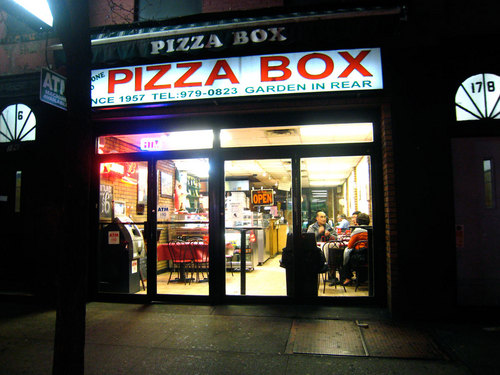
Say Yes To Pizza

SOURCE: nevinmartell.com

What does it take to have a good conversation with strangers in New York?

Apparently it’s not necessarily going to bars but getting the late-night pizza afterward.

After spending last Saturday night at a bar in Union Square, I sauntered outside with a couple of friends, John and Katherine. It was that critical point in the night when a decision must be made–get food or go home? As we walked down 14th Street we each silently weighed our options: Is there anything at all in the fridge? What about that gyro place next to my apartment…does it close at 3 or 4? Am I really that hungry or can I wait till tomorrow’s bacon egg and cheese?

We were all heading in our separate directions–me to Hell’s Kitchen, Katherine to the Upper East Side and John back to Hoboken, so a decision needed to be made soon.

John was the first to speak. “OK, it’s late, I’m going home.” Before I knew it he’d disappeared into the subway station.

Taking his cue, I said a quick good-bye to Katherine and continued west. But then my stomach starting growling, and the thought of actually having to prepare food when I got home settled in.

“WAIT!” I said to Katherine. “I’ll get pizza with you.”

She smiled, as if she’d known I would change my mind. “OK let’s do this,” she said.

And so we walked back the way we had come, returning to the only crowded pizza place on the block.

SOURCE: thedailymeal.com

We each ordered a slice–Katherine basic pepperoni and me this onion/mushroom/garlic/pepperoni concoction that looked incredibly appetizing at that late hour (and really was delicious).

We dumped some parmesan and oregano on our slices, grabbed two seats at table, and began eating our pizza in total silence, the way two hungry and tired friends can do without feeling awkward.

But we weren’t silent for long, because two guys asked if they could grab the empty seats across the table.

“Sure!” we said. One of them in particular was pretty attractive.

After introducing themselves, they started asking us some questions that seemed a little too formulated for random conversation.

“So,” one asked. “Do you guys use apps to determine what bar you go to on the weekends?”

“Um, I use Yelp to find restaurants and sometimes bars,” I said.

“I use Yelp and Foursquare,” Katherine said.

“What if you could find out LIVE information about a place, before you even get there,” the guy said. “What if you could know how many people are in a bar, what the atmosphere is like, what the ratio of male to female is, before you even walk in the door.”

“Ummm…” We looked at each other. We both work in the media world and could sense what he was on to.

“Are you creating an app?” Katherine asked. ” I work in consumer insights, this is what I do for my job.”

“You caught us,” he responded.

SOURCE: http://lostatseanyc.blogspot.com

They weren’t just two guys asking to sit down and chat with two girls. They were two guys pitching their product to girls in their target demographic, and getting to know us at the same time–which made the experience even cooler.

And so we discussed the merits of knowing too much versus too little information about a place. We talked about the limitations of such an app–if it didn’t immediately have hundreds or thousands of users, like Yelp and Foursquare do, how could we trust the opinions of a user base that may not be like us?

Katherine and I agreed that the only real way to determine atmosphere is to be there in person. Or maybe we’re just old.

I don’t know what time it was when I called quits on the conversation. Maybe 3:20, maybe 3:30, maybe 3:45. But it was late, and I had the sense these guys could go on for hours, or as long as we let them. (They were sober, and possibly caffeinated.)

I’m not an app creator and I need my sleep, but it was an awesome, intelligent conversation and an interesting experience. The kind of thing that I wanted, and expected, to happen when I moved to New York.

Lesson learned: ALWAYS say yes to pizza.

A Weekend in West Virginia

IMG_4376
Me in downtown Morgantown

When I told friends and coworkers in New York I was spending Memorial Day weekend in West Virginia, the response was invariably, “WHY?”

Most city folk spend their long weekends in the Hamptons, or the Jersey Shore, or various other locales about an hour or two outside of Midtown, so West Virginia is certainly out of the ordinary. But I had good reason to head out to the Mountain State. One of my best friends, Jolene, lives there and I wanted to see her and get a sense of her new life.

I also wanted to go far, far from the city, somewhere totally new.

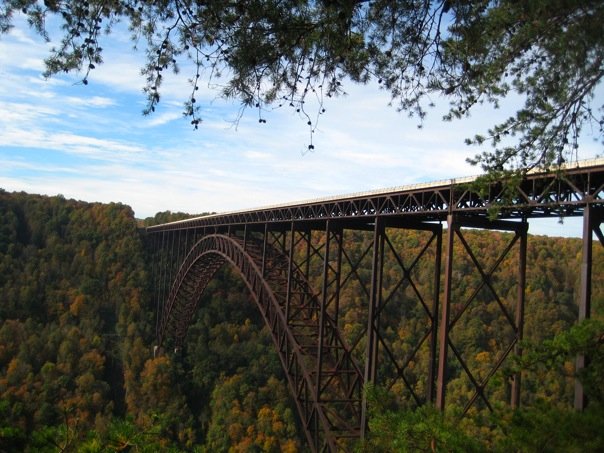
It wouldn’t be my first time to West Virginia. Sophomore year of college I spent a week in the southern part of the state, picking up litter in the Appalachian Mountains as part of a university service trip. Then, my senior year, a few friends and I drove through on our way to Hilton Head Island for spring break (yes, we blasted “Country Roads”).

From my 2009 trip to Appalachia
Taken on my 2009 trip to Appalachia

But I’d never been up north to Morgantown.

My other good friend, Laura, and I left from New Jersey early Friday morning, grabbing Dunkin’ Donuts coffees on our way. I was nervous about the drive, since I rarely get behind the wheel any more now that I live in the city. But my nerves calmed pretty quickly–I forgot how exhilarating highway driving can be.

The land rose and fell beneath us we moved into Pennsylvania and then West Virginia. We passed cows, horses and farmland. Over and over we marveled at how expansive and breathtakingly beautiful our country is, things one easily forgets when living in such a densely populated area.

The ride was pretty smooth, and aside from two Jersey girls trying to pump gas at a small country store (Billie’s was the name) with a single pump (what do you mean you don’t take credit cards?!) we made good time and arrived in Morgantown at around 3 p.m.

IMG_4385

After hanging out with Jolene’s boyfriend Will and cat Gilligan, the three girls went to a concert in downtown Morgantown. Saturday morning we checked out the shops and had a leisurely breakfast at an eclectic coffee shop called Blue Moose Cafe. It was a perfect setting for girl talk and catching up. We missed Jolene!  Growing up, you don’t think about your good friends moving far away. Even when you’re separated for college, you assume you’ll all be back together again eventually. But that’s not how real life works.

The sign of true friends, though, is when after months and months of being physically separated, things are exactly the same when you’re all together again.

IMG_4370
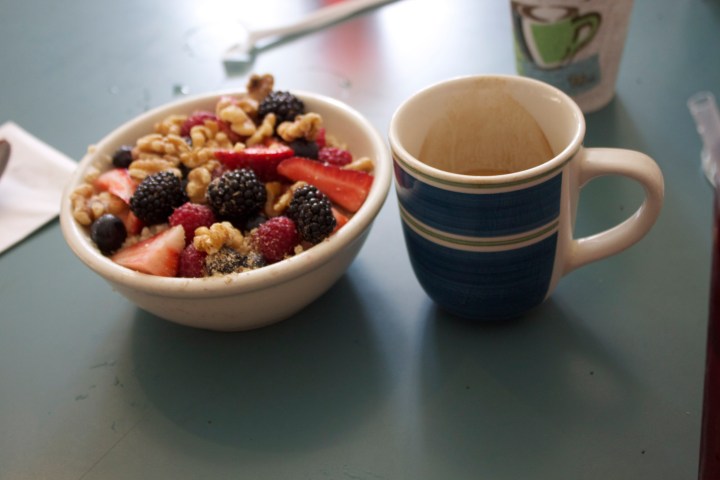
Laura’s breakfast at Blue Moose Cafe

Will’s parents own a lake house in Maryland, so we finished off the weekend in the idyllic setting of Deep Creek Lake. We arrived early in the evening on Saturday, ate sandwiches, and then sipped beers on the dock as we waited for the sun to set. It was incredibly relaxing–I’d forgotten what that kind of relaxation feels like. Since cell phone reception was spotty, I didn’t even feel compelled to check my phone, instead just enjoying a good book and good conversation.

The three of us out on the dock at Deep Creek Lake
The three of us out on the dock at Deep Creek Lake (Laura, me, Jolene)

Sunday morning we brewed coffee and espresso and walked down to the lake, watching the picturesque sailboats go by. Later, we sat around on their porch and drank white wine. Will’s parents were incredibly generous throughout the trip, putting together gourmet meals and making sure we all felt at home.

It was a wonderful trip–so great to see Jolene and experience her life in West Virginia. And as Laura said on the way back, we “broke the ice” with this one. More road trips are definitely  in store for us!

IMG_4189
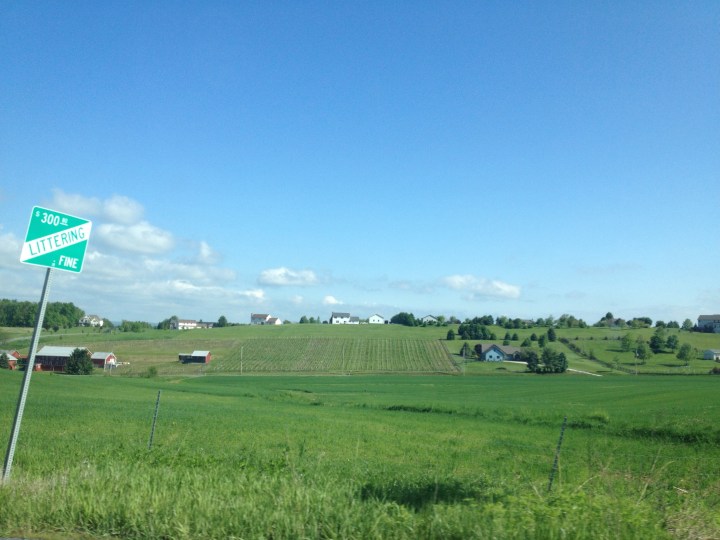
Farmland in Maryland

As sweet as vacations are, it’s always a great feeling to be home. Coming back to Hell’s Kitchen Monday night, I was happy to smell the $1 pizza, feel the pounding music from nearby bars, and hear the sound of hundreds of rolling suitcases hitting the streets.

My own suitcase slung over my shoulder, I walked the flight of stairs up to my apartment, the sunset over Deep Creek Lake  still tangible but fading rapidly into my imagination.

IMG_4437

The Cell Phone Samaritan

I was immersed in work one night at Starbucks when I heard a loud, raspy voice call out, “Excuse me, you dropped your phone!”

Instinctively, I looked to the floor for my pink case before I heard a woman say “thanks!” She reached under the table and picked up her iPhone. The man seemed to appreciate her appreciation and started chatting with her.

“Just today this guy dropped his phone outside. I called a number and got through to someone,” he said to the woman and the young man she was with, tone friendly as if they’d spoken before. “A $400 phone, and no thank you, nothing. I waited for an hour outside Rockefeller Center, too. Unbelievable.”

His anger became other customers’ anger, and soon four or five people in the store shook their heads in unison. It was the first time I’d seen everyone in Starbucks engaged in the same conversation.

“Next time it happens, I’ll throw the phone in the garbage can. I’ll throw it out!” The man was standing now.

“Do it!” cheered the young man with the woman who had dropped her phone. The woman smiled, offering her approval. Even the baristas momentarily abandoned their shop-closing duties to listen to what was going on.

Finally the man sat down, pleased with his good deed for the day.

I can only hope what goes around comes around for this Cell Phone Samaritan—even in a city where phones seem to evaporate the second they’re left alone.

Cover photo: “OR” by Thomas Leuthard/ http://thomas.leuthard.photography/

Scenes from the weekend

IMG_3544

Saturday morning run through Central Park. It was my first time visiting as a resident, not just a tourist, and jogging up the path to 81st Street without any agenda was glorious.

IMG_3549

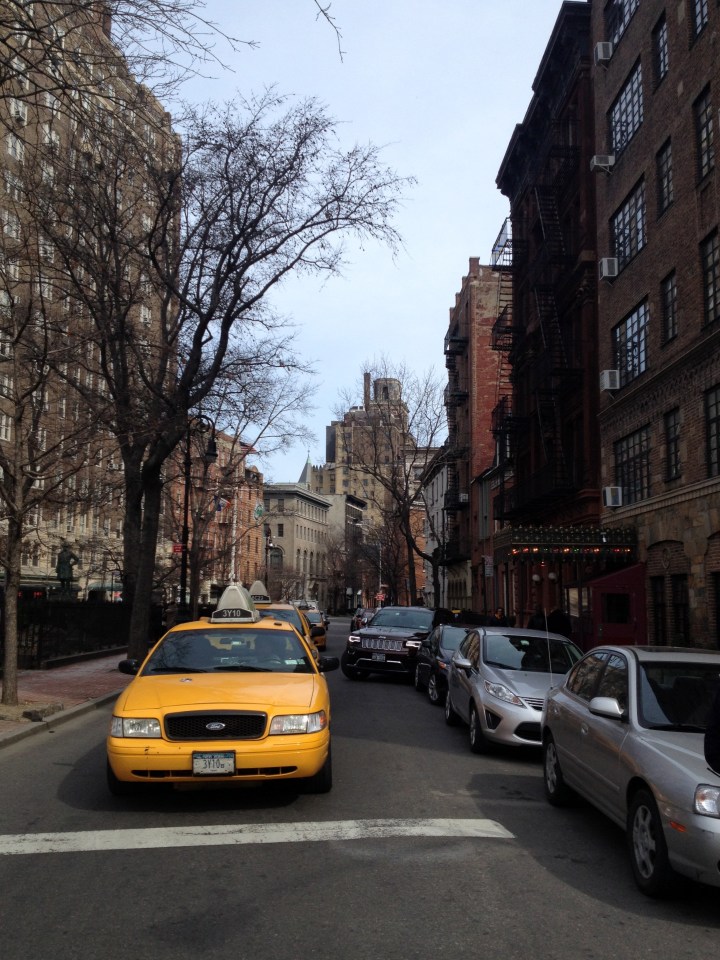
Sunday afternoon I wandered around the West Village, checking out the cafés (I have yet to find my go-to place.) It was cold, but I managed to take off my gloves to capture a few shots.

The Village is full of rich reds, browns and greens, and noticed how yellow taxis stick out here more than other places in the city.

IMG_3574

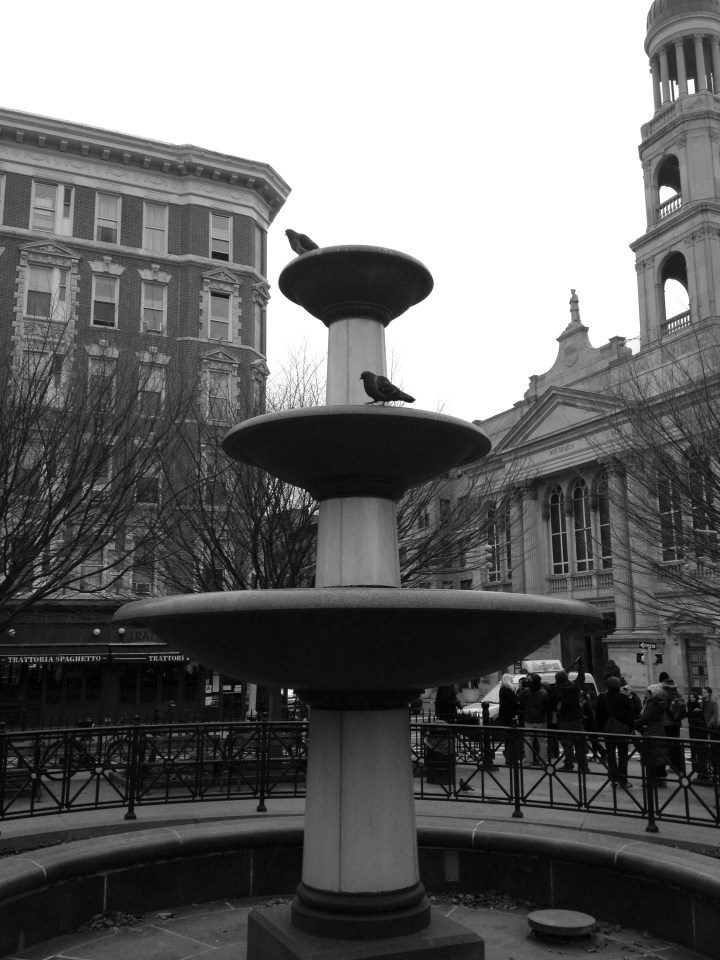
This West Village fountain is a refuge for the city’s weary pigeons.

IMG_3604

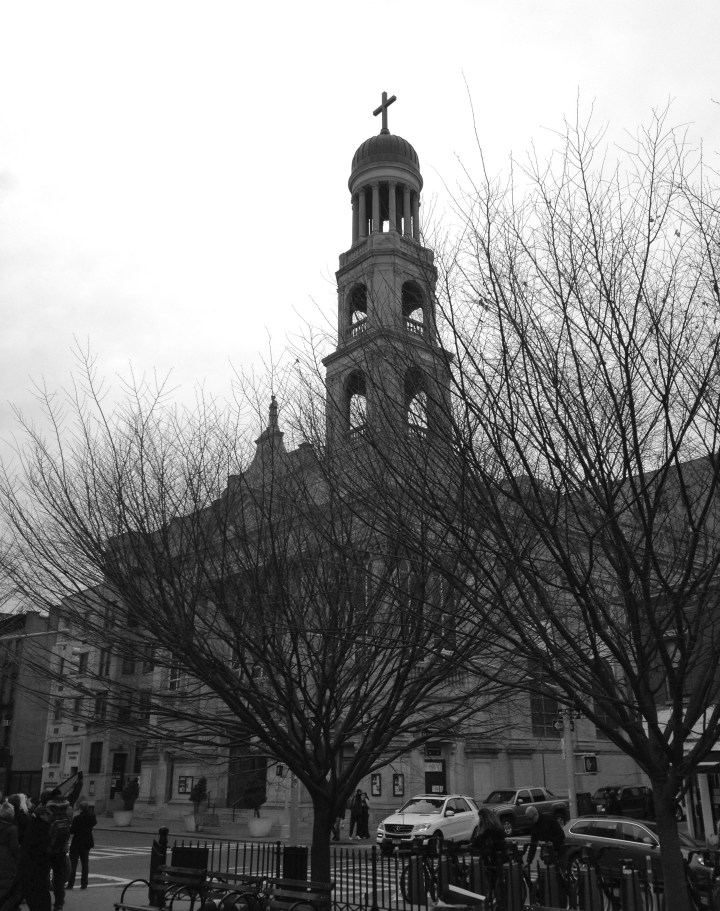
Our Lady of Pompeii Church on Carmine Street, framed by trees still looking bare and wintery. Hopefully spring is coming soon!
IMG_3609

The 42nd Street Hawker

mcdonalds

Author’s Note: This essay received honorable mention in Notre Dame Magazine’s 2013 Young Alumni Essay contest. It was first published at magazine.nd.edu.

I have walked past Geoff nearly every day for a year.

After getting off the bus in Midtown Manhattan, I need to cut two avenues east and seven blocks north. I always choose the path that goes down 42nd Street that passes Geoff.

Forty-second Street at 9 a.m. is one of the black diamonds of New York terrain. Commuters and tourists alike unload from buses at Port Authority — the busiest bus terminal in the world — and mix like oil and water on the streets. They mostly move in one direction, streaming through the city’s concrete arteries towards Times Square, its thumping heart.

I hit my stride as I walk down 42nd, expertly swimming through the crowds, spying then slipping into open pockets of space. I pass a glorified McDonald’s with a glittering golden arch, breakfast lines spilling onto the sidewalk. Pop music blasts from the “Ripley’s Believe It Or Not!” museum and larger-than-life video screens compete with the morning sun.

pics2

But as I approach the corner of 42nd Street and Seventh Avenue, a single man’s voice soars above the drone of music, cars and construction.

“Haaaave a great Monday! Enjoy that job!”

It’s Geoff, standing there in his usual spot beside the 42nd Street subway entrance. He’s handing out AM New York, a free daily newspaper popular with commuters. Geoff is a hawker, stationed at this high-traffic location and paid to deliver the paper to anyone who walks by.

“Enjoy your work, young lady! Have a great morning on your job!”

Geoff is different from other hawkers, though. He’s never aggressive, never thrusts the paper at your face, and always tells you to have a good day.

Geoff puts his entire body into the greeting, first making eye contact, then smiling and bouncing on his feet before shaking his fist in a way that says go tackle that day.Sometimes, I wonder if he thinks his job is getting New Yorkers to smile.

“Happy hump day! Knock out your work!”

Geoff looks to be in his mid-forties. He wears a red vest and baseball cap and sets his eyeglasses perched precariously on his forehead. He’s never fazed by the swarms of people coming out of the subway or the pounding music from nearby tourist traps. For hours he yells over it all.

subway
Photo by HelveticaFanatic http://www.flickr.com/photos/helveticafanatic/

“Only eighteen hours till Friday! Come on, you know it. That’s all we got.”

The smiles Geoff gives often go unrequited. Once in a while, someone will emerge from the subway and greet him. How ya doin’, my man? How bout them Giants? But many ignore him — absorbed in phone conversations — or take a paper without saying anything at all.

Months after I started passing “the man who hands out the papers,” I finally asked his name. It was one morning in August when the clouds hung thickly overhead but the crowds on the street were thin. People anxiously gripped their umbrellas, prepared for the oncoming downpour. It seemed like the right time to approach him, but I felt nervous for some reason, nervous to go from just another young lady to an acquaintance.

He handed me the paper.

“Thanks,” I said. “Excuse me, what’s your name?”

“Geoff,” he replied, a slight questioning tone in his voice.

“Geoff, thanks for being so…” I didn’t immediately have words to describe what I was thanking him for, but he understood. He smiled and fist-bumped me. After a few moments I turned around and looked back through the bustling crowds, catching Geoff’s eye. He was still smiling and waving at me from 50 yards away.

The scene is so absurd. It’s 9 a.m. in New York City and thousands of people rush, straight faced, to wherever they need to be. And then there’s Geoff, relentlessly happy, sending sparks of enthusiasm to anyone who walks by. For the most part, those greetings fall short of passersby, evaporating quickly on the hot, hostile concrete. But every once in a while, someone turns and smiled.

One day, a little old man, no taller than five foot four, struggled to make his way east down 42nd Street. Surrounded by Times Square lights, this man’s life just seemed dim. Briefcases, heels and tourists in matching T-Shirts rushed by him — yet he and his wobbling cane seemed to exist alone in the crowd.

“Have a great day, young man!” Geoff called out from beneath the subway awning.“Have a great day!” The man didn’t look up. He didn’t react. He just kept pushing forward, step by step by step.

I waited to see if he would turn around. He was likely a veteran New Yorker who had long ago learned to ignore the white noise of hawkers.

New Yorkers like him don’t believe in acknowledging hawkers. Street salesmen are everywhere, calling the same things, blending into the drone of the city. Maybe he feared letting in one hawker meant letting in them all, and he was too old, too weak to fend off these intruders of personal space.

He never turned.

I wondered how many people like Geoff I pass each day, but disregard in my hurry — how many faces and voices get lost among the city’s sights and sounds.

City girl

Source: michaelminn.net
Ninth Avenue. Source: michaelminn.net

I signed my first New York City lease about three weeks ago.

I was walking up Ninth Avenue before work, around 8:45 a.m. It was a slight detour from my usual walk east from Port Authority towards Sixth Avenue, and I loved the change of pace. Instead of passing flashing screens and packs of tourists like most mornings, I passed cafés, bars and bakeries with unique storefronts. Restaurant staff carefully etched the day’s specials into street-side chalkboards. People walked out of nearby apartment buildings, coffee in hand, keys jangling.

Clearly I wasn’t a New Yorker yet, because I broke out smiling.

I probably looked like an idiot, but I couldn’t help it. I was happy, exhilarated. I’ve been coming into the city every day for over a year and a half, and on occasion for my whole life, but today was different. Signing this lease would mean formally crossing over into a new phase.

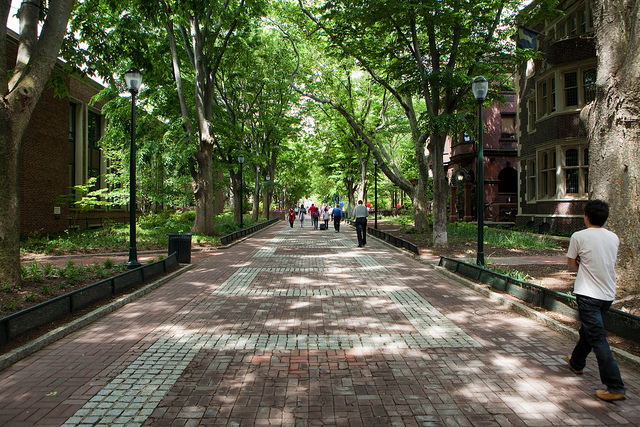
University of Pennsylvania's Locust Walk. Source: Alan Turkus.
University of Pennsylvania’s Locust Walk. Source: Alan Turkus.

The moment reminded me of another time in my life, about eight years ago, when I took a tour at the University of Pennsylvania with my parents. It was the very first college visit I made, the very first time I crossed a campus and thought in a few years I could be part of this. I remember loving the fast-paced campus where professors and students filed in and out of buildings, talking. I loved the intellectualism and sense of opportunity. The university had an energy I’d never experienced before, one that I’d go on to find at a number of other campuses.

After we finished the tour I said to my parents, “Let me go ahead for a minute. I want to feel like I’m in college.”

So I walked briskly and blissfully down Locust Walk, the main campus pathway, acting like I was a student. (I’m sure my wide grin and calculated stride gave my age away.) After a few seconds I turned and looked back at my parents, who were also smiling.

“You look like a real college student,” they said.

“Thanks,” I said, wanting to believe it but knowing I had a few years to go.

I felt the same excitement walking down Ninth Avenue a few weeks ago. But while Locust Walk spans a few hundred yards, New York City avenues go for miles. And this time, there were no parents to look back on. I was totally and completely on my own.

I smiled because I’d soon be part of this city full of lights and people and endless stories. I’d soon be part of this city I’ve loved since I was a kid, finally opening up to me, no longer just out of reach.

A Sign or a Sign?

I was walking down Ninth Avenue, somewhere between 45th and 50th Street, when pain overtook my left foot. Within seconds my quick stride halted, the couple I’d just breezed past gained 20 yards on me, and I was in danger of missing my bus from Port Authority back to New Jersey.

My toes curled and twisted, every muscle in my left foot erupting in mutiny of the heels I’d been wearing all day.

I didn’t stop. For a block and a half I walked, dragging my left foot behind me, careful not to catalyze any further spasms. I expected confused looks (or sympathy, maybe) but no one seemed to notice. After all, a limp is hardly the strangest of sights in New York.

Too far from the A-C-E lines to take the subway, I finally just stopped to wait for the pain to subside. Leaning against a storefront in the eight-degree cold, I watched couples holding hands, friends leaving dinner and suits stumbling out of happy hours. I felt awkward standing by myself while watching all these people pass, and realized my fingers were too cold to even distract myself with my phone.

After a few minutes I turned around to look inside the closed store. A glowing neon sign faced me, reading: “BACK AND FOOT RUB.” I laughed out loud.

Some would say it was coincidence, but I believe the city has a way transforming into exactly what you need it to be, at any given moment. By the time my smile faded, so had the pain, and I continued on.

I knew this was the New York’s way of telling me, “I got you.”

Lula’s Café: The Community Living Room

Photo Source: 365 South Bend Blog

*Author’s note: this article was first published in Notre Dame Magazine at magazine.nd.edu. 

I had never seen this much flannel in one place at Notre Dame. The room was filled with men and women in plaid shirts, and standing at the microphone was a poetry student from Notre Dame’s creative writing M.F.A. program, reading selections from her work.

A few girls “whoop whoop” and others in the audience clapped, smiling at the student’s cleverness. This group thrived on wit, intellect and the beauty of language.

The décor was an eclectic mix of things that shouldn’t go together but somehow did. Sunflowers sprang from the walls beside oddly shaped mirrors. Shelves held books and random knick-knacks. A wall was painted in red and yellow stripes, and a dusty emerald lamp hung in one corner. None of it made logical design sense, but that was the whole idea of Lula’s—letting loose, being creative and taking risks.

Mostly M.F.A. students filled the room that night, but scattered throughout were undergrads and professors. In the middle of the readings, two huge football players walked in, dressed head-to-toe in Notre Dame gear. They were out of their element, and intentionally so. There was just something wonderful about that.

16 years of Lula’s

“It was a happy accident, really,” Lula’s owner Steve Egan ’93 told me over coffee one fall morning in 2010. “Lula’s was a hit right away.”

The idea for Lula’s was born 16 years earlier when Egan, a public accountant in Chicago, talked over dinner one night with a friend and Notre Dame alum about opening a café near campus. “There was nothing like Lula’s in South Bend,” Egan recalled. “I felt pretty confident in the idea.”

“I did the benchmarking at every café in Chicago practically, to just kind of figure out ideas, and figure out as much financial data as I could from the owners who would be forthcoming with it,” he said.

The next step was writing a business plan and executing it.

“We wanted to be close to campus, and this was a good crossroads area, with high traffic,” Egan said of the 1631 Edison Plaza location, at the Edison/23 intersection near The Linebacker. “I didn’t leave my job in Chicago until we had a location that made sense.”

From the very beginning, Lula’s was meant to be more than just a café — inspiring the sharing of ideas and life stories. And Lula’s was always intended as a bridge between South Bend and the surrounding campus communities, including Notre Dame, Indiana University South Bend (IUSB) and Bethel College.

“We wanted to break down barriers … misconceptions that people from town have about people from campus, and vice versa,” Egan said in 2010. “We wanted to appeal to all demographics. I think that’s one of the tricks to Lula’s, that it’s been able to appeal to a lot different types over a long period of time.”

But after 16 years it became apparent that Lula’s time — at least its time on Edison Road — was limited. On October 5, 2010, Egan spoke to an entrepreneurship class at Notre Dame. The very next day, he was surprised with a notice that his lease would not be renewed.

Egan had just 50 days to vacate Lula’s.

After months of searching for a new location, Egan let go of the dream and took a job with Anthony Travel. Egan said one of the blessings of going through this change was hearing what Lula’s had meant to so many different people.

“It’s kind of like getting to hear your own eulogy when you’re alive,” he said then. “That’s a powerful affirmation that Lula’s has mattered to a lot of people. Lula’s has meaning outside of just a restaurant or coffee shop. There’s something deeper here.”

“The community living room”

Over the years, Lula’s was called “the community living room,” “the gateway to South Bend,” and “the place in Michiana where people come to try to save the world.” Lula’s embraced open-mindedness, encouraging its customers to sit, talk and stay awhile. Students perched at corner tables with laptops, books lined shelves like a library, and cards and board games invited customers to play over coffee or after meals.

“We created so many collisions,” Egan said, explaining that Lula’s was a crossroads for people, communities and ideas. The cozy, thought-provoking space attracted college students, Midwestern hipsters, counter-cultural high school kids, professors and professionals.

“Somebody said, ‘That’s one great thing about Lula’s: you can be next to a nuclear physicist, two high school kids on a date, and two grandmas playing Scrabble,” Egan recalled.

Egan attributed Lula’s success to its customers and staff, the good food and drink, the community and cultural events it hosted, and its general “vibe.” He said customers who recently moved to South Bend were told, “the first place you need to go is Lula’s. That’s where you need to start connecting to people.”

When I arrived on campus in the fall of 2008, I struggled to find a place that felt just “right.” As a quiet freshman uprooted from my New York City suburb, I needed more than Notre Dame football and tight-knit dorm life to feel at home. I often complained to my family that I hadn’t found a community of writers on campus. In fact, I hadn’t found any arts community at all.

One day I heard about a poetry reading at Lula’s Café, which was close enough to campus to walk. I fell in love at first sight. The relaxed atmosphere, friendly staff and delicious food welcomed me right away. Lula’s became a refuge when campus was overwhelming or when I just needed to think.

And Lula’s had been that safe haven, that escape, that home away from home for many.

Matt Storin, a former Boston Globe editor who worked and taught at Notre Dame, said Lula’s helped compensate for South Bend’s inadequacies as a college town. “I was originally attracted to Lula’s because it reminded me of what a college-town coffee house or restaurant should look like,” he said. “Being from the East Coast, I felt that it had a kind of Cambridge-like feel.”

Lula’s last call

Egan said closing time was bittersweet, but he felt an outpouring of support as Lula’s history at Edison Plaza came to an end.

“The last day was a tremendous day,” he said. “Both Tuesday and Wednesday were two of the best days we ever had. I gathered the staff at about nine, and in true Lula’s fashion there were customers and friends of staff just hanging around. We all went around and talked about what Lula’s means to us and the community.”

Lula’s final day of operation was Wednesday, November 24, 2010. It closed for good on Thanksgiving Day. Lula’s staff spent the next few days taking the restaurant apart, and by November 30, all that was left at 1631 Edison was an 8×11 inch sign on the door.

Another café followed but didn’t stay long, and the space once filled with Lula’s is still vacant.

“Give my regards to Broadway”

I met my grandfather (Papa) in New York City last Saturday for a couch-shopping excursion followed by lunch.

I noticed he blended in so nicely with the city in his handsome trench coat and hat. He looked like someone right out of Humans of New York, and I knew he’d have a quote sufficiently poignant if ever stopped. Or a song lyric.

Papa has a song for everything, and as we were walking he began singing “Give My Regards To Broadway.”

Give my regards to Broadway
Remember me to Herald Square
Tell all the gang at Forty Second Street
That I will soon be there.

We went to the Macy’s in Herald Square. He told me how my great-grandfather (his father-in-law) was a carpet salesman there in the 30s and 40s. I love spending time in the city with Papa because he’s full of old stories about the places I pass every day. The buildings and streets glow with history. Even the not-so-pretty, not-so-famous sites transform through Papa’s memories, flickering for a moment in the form they once were.