Constantly in motion: How New York City’s waters shape its identity and culture

“Yonkers Esplanade, Municipal Pier, George Washington Bridge, Airborn Friends” by Peter, https://shorturl.at/hBWss. License at https://creativecommons.org/licenses/by/2.0/

“Yonkers Esplanade, Municipal Pier, George Washington Bridge, Airborn Friends” by Peter, https://shorturl.at/hBWss. License at https://creativecommons.org/licenses/by/2.0

On foggy days clouds wrapped the bridge in a thick, wooly blanket, blocking the view except for scattered lights strong enough to punch through the fabric. But on clear days my eyes drifted toward the skyline to take in the tall buildings that stood proudly at the water’s edge.

As a child I loved peering out the window at the Hudson River as we crossed the George Washington Bridge on the way to my grandparents’ house on Long Island. Passing over the congested bridge always took longer than expected; I sometimes wondered if I’d get to the other side faster by swimming.

“It’s rougher than you think,” my mom would say. “Strong currents would sweep you out to sea.” I quickly became fearful of the river, seeing it as a threatening being, one we could pass over or under but never get close to. I imagined anyone who dared jump into the water would be immediately swept away and consumed by the great mouth of the Atlantic. 

Still, I always felt sorrow on the way home as I saw Manhattan’s lights twinkling in the water. I knew it could be months before we’d return and I’d get to see the river and the buildings in all their grandeur.

The island I’d cross through on childhood trips from New Jersey to Long Island is now my home. In my ten years of living in New York City, my relationship to the river has become less symbolic and more intimate. Whenever I need to make a decision, I’m drawn to the water—it provides a vantage point from which to gaze out beyond the nearest phone or traffic light or computer screen.

I believe the waters around New York City are the silent architects of our history, culture, and daily lives. Think about it: life along its shorelines started with indigenous tribes. The water around us has been a source of commerce and transportation for thousands of years. And our world-famous skyline wouldn’t be possible without the Hudson River, which stops us from endlessly widening this concrete ecosystem. We rarely pause to recognize the waters’ significance, but doing so can deepen our connection to nature and help us find serenity in our everyday routines.

The Lenape people who first inhabited Manhattan called the Hudson River Mahicantuck, which means “great waters in constant motion,” because of the way the tide shifts directions throughout the day. Each day the river continues this way, moving both upstream and downstream at the same time. I believe the waters connect our past and present, grounding us in who we are.  


My father grew up in the 1960s in Brighton Beach, a Brooklyn neighborhood named after the coast of England and situated in the shadows of Coney Island. Despite living one block from the ocean, my father and his family rarely spent time there. Each summer they escaped for two months up to the Catskills, trading sandy city beaches for the fresh mountain air.  

Still, the water was the backdrop of their lives. Until high-rise condominiums sprouted up and blocked the view, my father could see the ocean from nearly every window of his sixth-floor apartment. And at night, when the ocean blended into the sky, rendering the view imperceptible, he could still hear the far-off sound of the waves. It was comforting to listen to, especially after a rough day.

Living by the water, my father had more open space than the typical city child. He wasn’t wedged into a busy urban environment since his apartment building was the last one on the block before the beach. As a young adult, he’d run the boardwalk all the way to Coney Island and back the other way to Manhattan Beach. He remembers passing elderly people chatting on benches and lively characters dancing unabashedly to the loud music of their boom boxes.  

Life was freer there, by the ocean.

Like many New Yorkers of the early 20th century, my great-grandparents arrived in the U.S. by way of the Atlantic Ocean, from Ireland on my mother’s side and Eastern Europe on my father’s side. My father’s family came from Galicia, a historic region that spans what is now Southeastern Poland and Western Ukraine. Eastern European Jews like my great-grandparents eventually settled in Brighton Beach to escape the overcrowded conditions of the Lower East Side and breathe clean air by the water.1 In the 1940s, the area was also a haven for Holocaust survivors and refugees seeking a primarily Jewish neighborhood.

In the mid-1970s, the neighborhood saw a large influx of Ashkenazi Jews from Russia and Ukraine, eventually earning the nickname “Little Odessa” after the Ukrainian port city on the Black Sea.2 Even as immigration slowed in the following years, the Eastern European influence held strong, with shop signs in Cyrillic and the scents of Georgian flatbreads and Russian sweets making their way into the streets. In that small corner of beach on the other side of the world, my relatives and others like them created a sense of home.

The beaches of Little Odessa face the south and get sun throughout most of the day. That orientation led the Lenape who lived in the region to refer to it as Narrioch, or “land without shadows.” I like to think the people from all over the world who’ve settled in that area of Brooklyn share a few things: a desire to turn toward the light and a sense of belonging from living beside the water.


I like to think the people from all over the world who’ve settled in that area of Brooklyn share a few things: a desire to turn toward the light and a sense of belonging from living beside the water.


The Lenape people had a reverence for water that we’ve largely lost in modern society. This is reflected in their vast and varied language, which has at least 35 different ways of describing water, including sukëlàntpi,or “rainwater”; mushpèkàt, or “clear water”; shawpèkunk, “place at the edge of the water”; and hikahële, “a creek or river that has run dry.”3

Before Dutch settlements, the Lenape who lived in villages along the Hudson River shifted locations with the seasons to take advantage of the available natural resources. Some sources say there were between six and twelve thousand people living in small groups on the lower estuary, connected by and surviving off the river.4

What did we lose when water became a source of power and commerce, not just a source of life? While our legal system today focuses on individual rights and structured political processes, the Lenape Laws were more of a guide on how to exist communally in the world, with one of the laws stating, “We are all relatives. Respect all relations.”

“This Lenape value stresses the interconnectivity of all things,” said Joe Baker, co-founder and executive director of the Lenape Center and an enrolled member of the Delaware Tribe of Indians, in a talk at the Brooklyn Public Library. “Indeed, the land, the sky, and all life exist as an interdependent, interconnected web where no single element or being was void of its own place and embodied spirit.”5

Of course, our survival is no longer tied to the river. But we should all learn from the idea of interconnectedness that Baker spoke of. Today, individuality governs our actions and puts up artificial barriers between us and the nature surrounding us. And with the erasure of that connection came the erasure of Lenape history and their access to home.

The arrival of European settlers upheaved the Lenape way of life. Although history books cite Dutch merchant’s Peter Minuit’s purchase of the island for goods valued at 60 guilders (then about $24), the “purchase” of Manhattan is mythical, more of a forced displacement than a true exchange. After all, the Lenape did not understand or abide by the concept of land ownership. Over time, many of the Lenape people were forced to move out to reservations in Oklahoma, and their ancestors today ache for a homeland they may never have set foot on.6

The idea of owning an element of earth was completely foreign. As Baker and his co-authors wrote in Lenapehoking: An Anthology, “How could the entirety of the vast Earth, ocean and sky, clouds, streams, rain and wind be reduced to a sheet of paper? It would not have been any different than someone today laying claim of ownership to the sun.”7


Recently I learned that the Hudson River’s journey is 315 miles long.8 It starts at Lake Tear of The Clouds in the Adirondacks as fresh water, rushes over rapids and waterfalls, and then flows past small towns and cities, mixing with salt water before it comes to an end in New York City.

Through all the changes on land, the river still flows in both directions, just like it did thousands of years ago. It’s a strip of the natural world in New York City that seems relatively untouched, save for ferries and boats and bridges that interact with the water but can’t contain it.

The Hudson River, the Atlantic Ocean, the East River, and all the bays, streams, coves, reservoirs, and straits define us as much as the streets and buildings do. They are active participants in urban life—or rather, we are active participants in their ongoing cyclical journeys. Perhaps city life isn’t as individualized as it seems. We just need to think beyond ourselves, appreciate our place in the natural world and properly understand the history of those who came before us. We must recognize that before this city was a city, it was “Man-hatta,” a “hilly island” rich with natural resources, a homeland.

There’s a promenade where I can watch the tides move north and south as seagulls take flight from the river railing. Looking across the water to New Jersey, I’m reminded that nothing is still; nothing is permanent, and everything is connected.  

Nature is here, all around me. These Great Waters Constantly in Motion.


References:

[1] “Brighton Beach.” Brooklyn Jewish Historical Initiative, https://brooklynjewish.org/neighborhoods/brighton-beach/. Accessed 23 Jun. 2024.

[2] “Neighborhoods.” Brooklyn Jewish Historical Initiative, https://brooklynjewish.org/neighborhoods/. Accessed 23 Jun. 2024.

[3] Delaware Tribe of Indians. Lenape Names for Other Terms for Water. Delaware Tribe of Indians, 2024, https://delawaretribe.org/wp-content/uploads/Lenape-Names-for-other-terms-for-water.pdf.

[4] “The First People of the River.” Riverkeeper, Riverkeeper, Inc., www.riverkeeper.org/hudson-river/hudson-river-journey/the-first-people-of-the-river/. Accessed 9 Mar. 2024.

[5] “The Land We’re on: Living Lenapehoking | Live from NYPL.” YouTube, New York Public Library, 7 Mar. 2023, http://www.youtube.com/watch?v=ycGoioaKpxQ.

[6] “True Native New Yorkers Can Never Truly Reclaim Their Homeland.” Smithsonian Magazine, Smithsonian Institution, 15 Aug. 2018, www.smithsonianmag.com/history/true-native-new-yorkers-can-never-truly-reclaim-their-homeland-180970472/.

[7] Baker, Joe, Hadrien Coumans, and J. Whitney, editors. Lenapehoking: An Anthology. Brooklyn Public Library, 2022. Brooklyn Public Library, https://discover.bklynlibrary.org/item?b=12581674.

[8] Madelone, Jake. “Can You Swim in the Hudson River?” Waterfront Alliance, 29 June 2023, https://waterfrontalliance.org/2023/06/29/can-you-swim-in-the-hudson-river/.
Where did she go?

Sometimes, the stress and chaos of everyday life results in a chasm of creativity. And even if these chasms are short-lived, they can have a powerful effect on happiness. This prose poem explores the feeling of losing access to inner peace and an important sense of knowing yourself, but remembering how it felt when your identity was whole and creativity abundant.

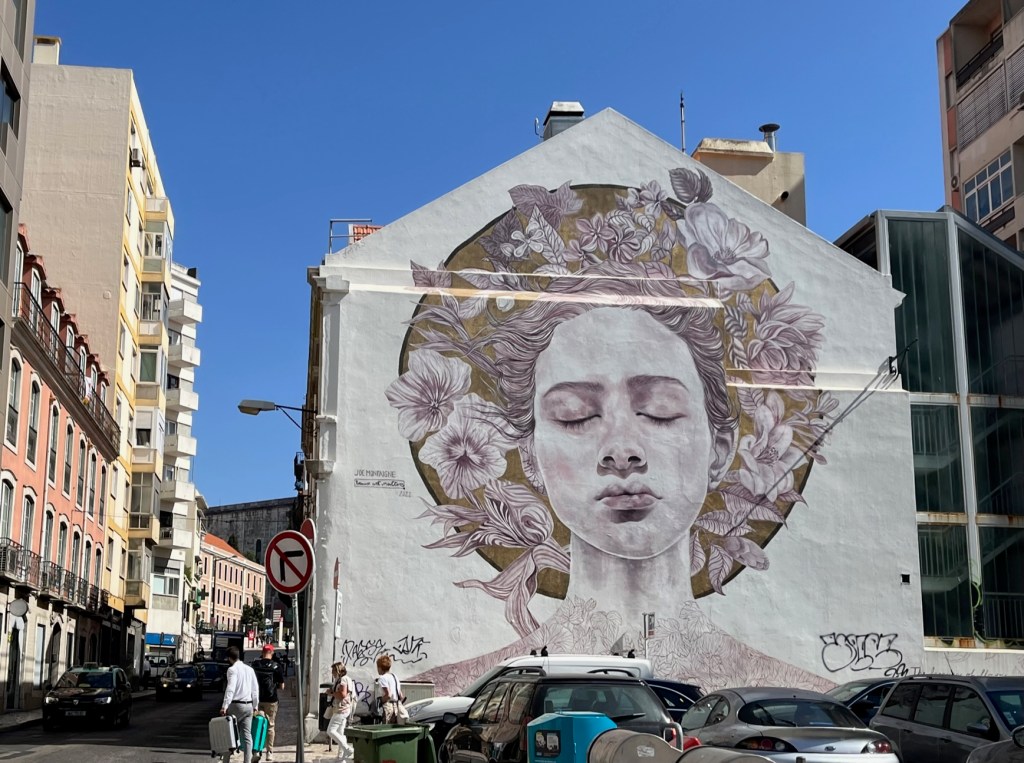
The image below is a photograph of the Lisbon mural ”The Language of Flowers” by Jacqueline de Montaigne, a work of street art I always found beautiful in its silent , self-reflective melancholy.

—–

Where did she go?

I need to feel more. Feel deeply. The kind of feeling that brings tears to your face so quickly you’re not sure if they’re happy or sad, or something even more elemental.

All the focus and the attention directed outward leaves the inside bare. Staring at Zoom screens, Google Maps, New York Times alerts, FaceTime calls; collecting and storing passwords the way people used to guard their jewels. It’s like the edges of me have blurred into the speeding subways, the rush of emails, the blazing billboards, pieces falling into those sad construction zones that sit idle for years. Where does the city start and I begin? 

I wasn’t built this way, to blur around the edges. I was built to turn inwards, toward the core myself, turning ideas over in my mind like shells brushing against the sea floor – until they’re smooth, polished, ready to land on shore, having journeyed long out of sight before their arrival.  

I’m furious in my dreams lately, cramming creativity into sleep where it doesn’t show up while I’m awake. Turning pages of imaginary books with the backs of my eyes and traveling to jagged, Picasso-like places until I wake up and get ready, trying to match the outline of myself with who I really am. 

I get lonely quickly but still need to be alone. Crave it. That sense of losing and finding myself again in the words of a good book, a meal carefully prepared over hours, a journal filled with scribbled handwriting I’ll one day make sense of. It’s a vital energy source – looking inward, imagining.

I was built to wear my ideas proudly like a colorful patchwork coat. I’ve always done that; I used to that. And yet I show up every day in gray.

I need me.

Where did she go?

Lessons learned from my college newspaper

Late nights. Early mornings. Not enough coffee in the world to keep you awake during that morning calculus class. It’s a story most college newspaper editors know well but would never change. We’re willing to put in the hours not only because of the close-knit community, one of the biggest draws, but because the skills you learn working for a college newspaper are invaluable across professional industries. Here are five reasons why.

You meet a wide range of people.

College is a bubble, but working on the paper exposes you to a wide range of people and viewpoints. During my four years on The Observer at Notre Dame, I interviewed a British literary scholar, the Chief Marketing Officer of Subway, the University president and the only Orthodox Jewish student on campus. Reaching beyond the bubble has huge value later on in the working world.

You get used to criticism.

Most professors at Notre Dame weren’t outwardly critical of my writing, focusing on what I could do better instead of what I did wrong. While I appreciated this approach in my classes, criticism is an unavoidable aspect of the professional world and life in general. My freshman year, I remember the first article I received back from my editor was completely covered in red ink, entire sections crossed out. I probably went home and cried that night, but soon learned not take things so personally (and that criticism helps you improve).

You master the art of succinct writing.

I used to think the phrase “writing is an art” meant I could use an unlimited number of words to make things sound beautiful. Now I believe that regardless of the writing form, every single word needs to have a purpose. Working on the paper taught me to boil down stories to their very core, write conversationally and include only the most powerful quotes. All of this prepared me well for a career in digital media.

You get comfortable leading conversations.

Most people love talking about themselves. Once you learn that, asking questions and leading conversations isn’t all that hard. When I started out as a reporter, I was scared to even place a call to a stranger. I read and reread my emails 10 times before requesting an interview. But with experience, I gained the confidence to assert myself during interviews, pursue contacts and ask the tougher questions.

You learn to work well under pressure.

Some of my most stressful days in college, I was under deadline for an article on the same day I had a major test. I spent free moments calling sources and writing while simultaneously trying to memorize history or statistics formulas. The Observer demanded everything of you, and you had to figure out how not to let your grades slip. It took years, but I learned to stay calm and trust that everything would get done (and that the world wouldn’t end if it didn’t).

I loved being an English major at Notre Dame. But truthfully, none of my classes stand out to me years later the way my days and nights spent in The Observer office do. While I nurtured my love for literature through my major, the newspaper that gave me the hands-on, practical education I needed to jump into the real world after graduation.

In the end, I’m thankful for the sleepless nights and overconsumption of chocolate. The Observer was the best (free) course I took at Notre Dame.

*This column was originally published in The Observer 

Jumpstart the thought process…

Graphic courtesy of facebook.com/friesenpress

I hate the word “flow,” I really do. But sometimes when you follow the above advice, the words just flow onto the page. There’s a good chance you’ll delete most of those words later on, but you’re in a much better position than simply staring at the screen, trying to force a vision that won’t come.

A Fiction Writer’s Manifesto

Photo by Enoch Wu

Fiction is both a personal form of expression and way of commenting on events that affect the population at large. Fiction should strive for beauty because it can — so many other forms of writing do not offer that freedom. My fiction writing is not rebellious nor is it experimental but it is definitely influenced by the fast-paced writing forms of the online world.

My work makes use of two opposing writing styles and constantly displays a tension between them: the succinct phrases characteristic of journalistic writing and the metaphoric imagery characteristic of poetry. I like to approach fiction methodically — as I would in journalism, but with feeling — as I would in poetry. My fiction is based off these two types of writing, yet falls somewhere in between them.

When composing fiction, I strive for five main characteristics:

  1. The beauty of the written word: Fiction is an art form, so I want my words to sound beautiful, regardless of the subject matter. Using words with a history of alternate meanings — and being conscious of those alternate meanings — can help deepen the implications of a story. Words in fiction should sound beautiful together despite the content or subject matter. However, the definition of “beautiful” can vary depending on the story. That being said, images should not be beautiful simply for the sake of being beautiful; they should also play a larger role in the storyline.
  2. Economy of language: This characteristic fits hand in hand with the previous one. I believe simplicity of language adds to a story’s beauty — the simpler something is conveyed, the more emotionally resonant it is. Portraying beautiful images in minimal words is extremely difficult to do, and is a great accomplishment when it is achieved.
  3. Engagement in current events: I tend to write fiction that is, naturally, influenced by the events going on around me. I also intentionally create fiction that comments in some way on a relevant societal issue. I’m careful to make that issue a central motif without explicitly stating it. Building up the tension of a problem without outwardly addressing it creates a foreboding tone; not saying something outright can make its presence in fiction even stronger.
  4. Focus on realism: I almost always write in the realist style. I’m not comfortable writing in genres like fantasy or scientific fiction, but those genres also aren’t conducive to the goal I have to shed light on issues that might be otherwise brushed over. My stories tend to begin quite ominously but in familiar and typically comfortable settings — I want the reader to feel uncomfortable from the beginning without knowing why. Then, slowly, small details are dropped so that discomfort deepens. Through a focus on realism, I try to address topics that might be painful or taboo in casual conversation.
  5. Multiple narrative planes: I envision my writing as moving in several directions at once, all convening somehow in the ending. My goal is to set up these different narrative planes early on in the text, but write with enough authority that the reader is convinced each has its own purpose. Sometimes these layers are created by integrating different kinds of writing, including poetry, journalism and essays, into the fiction itself. The various layers also help create endings that are somewhat ambiguous but still convey a specific feeling.

My writing is generally traditional. I love writing in the vignette style in particular because it allows me to incorporate poetic phrases naturally into fiction. Vignettes give me the opportunity both to create the beauty that I strive for and to comment on a single issue from a number of different perspectives.

As a young writer, social media and online writing inevitably influence my work, since those are things I engage with on a daily basis. Despite most forms of writing being in a state of such rapid change, however, I believe traditional, printed fiction continues to be crucial today. The mind processes ideas differently when work is read on the printed page versus when it is read on a screen, so the printed page is necessary even as the world of digitally published fiction expands. A goal for my future work is to reconcile these two sides of fiction, always keeping in mind how a story will be interpreted differently depending on whether it’s displayed on a digital or traditional background.

Top 5 places to write outdoors

Swimming. Sundresses. Street fairs. There are so many things to love about summer, but writing outside may be my favorite. I have a few months to go before I begin my new job, and I’ve been trying to get some sun and catch up with reading and writing in the meantime. Here are some of my all time favorite spots to ponder ideas, scribble down thoughts or seriously write.

1. On a city bench (eavesdropping)

I learned this trick at the Iowa Young Writers’ Studio back when I was a junior in high school. There’s no better source of inspiration for a story than picking up and trying to piece together scraps of conversation from daily life. Listening to entire conversations is okay, too. I mean when you’re out in the public it’s fair game, right?

2. The back patio of my house

It’s away from the commotion, but close to an endless supply of snacks and San Pellegrino!

3. The second floor balcony of the Concord Suites in Avalon, NJ

Each year since I was about 11 my family has gone down to the Jersey Shore and stayed at the same hotel, the Concord Suites. The second story of the building has a wide balcony with tables that look out over the street. I love the clear, breezy nights when you can see the stars, and the combination of hushed conversation of and the hum of the ocean makes for the perfect background sound. Every year I try to write at least one poem from up there.

4. The bench and table at St. Joseph’s Lake in Notre Dame, IN

I never actually wrote here, but my roommate Megan and I would often go for runs around the lakes at school, and each time we passed this spot I’d vow to come back with my notebook. Basically, there’s a charming little writing desk off in a tree-shrouded area beside a beautiful lake, and I never actually see anyone using it.  I’ll definitely have to find some time away from bookstore-shopping and tailgating to come back here during a football weekend.

5. Sitting outside a café 

Okay I may be cheating a little bit with this one, because obviously a café is an ideal spot for writing. But writing OUTSIDE a café  is most ideal!  I love the outdoor tables certain coffee shops have, where you can sit with your laptop, enjoy your latte and the warm weather and still observe people on the street.

It’s a…blog!

Dear friends,

As many of you know, I’ve been wanting to start a blog for some time. I love writing, photography, and aimless searching online, so a blog always seemed to be the perfect fusion of my interests.

The summer after my first year in college I interned at a New York based company called Magnet Media, writing blog posts for the photography and design channels of their website, Zoom In Online (Now The Photoletariat). Each day, I’d take my free trade coffee up to the tenth floor of the Chelsea office building, feeling as hipster as a freshman Notre Dame student from a preppy suburban town could feel. I loved my job and was fascinated by the blog world, by how entire communities existed online and artists exchanged ideas through comments and links and shoutouts.

But then summer ended and school started and I forgot about my quirky little pastime. Two years later, I’m finally giving it another try. This blog will contain my own creative writing and photography and finds from the design world.

Hope you enjoy!

Sara