Anthro & Anthora

Few window displays compare to Anthropologie’s. They’ve really got design down in their stores. I love this arrangement of the iconic Anthora coffee cup, each one filled with a small plant, at the Rockefeller Plaza store location.
(Look closely and you can see 30 Rock reflected in the window.)
Mother’s Day and Last-Minute Gifting
It’s Mother’s Day morning and young men and women emerge from apartments all over the city, dreary-eyed and caffeine-deprived, on the quest for that perfect last-minute gift.
Many of us were excused from present-buying duties during our college years. In those days, a simple phone call and card sufficed.
But ever since we’ve become “real people,” our mothers have begun expecting “real presents.” And rightly so.
The hard thing about Mother’s Day, though, is that it’s on a Sunday. Sundays are right before Saturdays, which are right before long workweeks. Long workweeks come before other long workweeks, when Mother’s Day is still just an embryo of a reminder on our iPhones.
But then—suddenly—the day arrives. The iPhone alarm rings and rings. Early risers post Instagram collages and poetic Facebook statuses in their mothers’ honor, while the rest of us still lie in bed, fighting off Saturday night.

When the clock strikes 12 noon, the pressure’s on.
Now, the amount of love we have for our mothers and the amount of time left till Mother’s Day dinner do not correlate. In fact, some of the latest gift-buyers are the most dedicated, roaming the streets of New York during the wee hours of brunch.
They are driven by love, and they are driven by guilt. They are driven by an extra-large coffee from the local bagel shop.
And they won’t show up empty-handed.
Having stayed with some college friends in the city that Saturday night, I joined the pack of last-minute gift-buyers Sunday morning.
Luckily, New York City came through for me no fewer than five minutes after emerging from my friends’ apartment. As I crossed 71st street, I saw a table overflowing with flowers ranging from lilies to orchids to roses.
Tucked among the array of colors, I spotted the perfect bouquet of 12 roses—six red and six white. They were classic, beautiful and exactly what my mother would like. I fished a crumpled 20 out of my purse and handed it to the man behind the table.
I turned and made my way toward the 72nd street subway, pushed through the turnstile and hopped on the 1 train to 42nd Street.
As I left the subway and walked down 42nd towards Port Authority, I noticed the bouquets became more frequent. In fact, they were everywhere. New York City was now dotted with these colorful, tangible representations of love.
But what’s a bouquet without a card? I stopped in the Duane Reade at the corner of 42nd and 8th, not prepared to meet swarms of my fellow last-minute gift-buyers in the cards section. I had just 15 minutes till my bus embarked for Jersey. I waited on line for my chance to pick one out, borrowed a pen from the cashier, and made it to my bus just in time.
After 30 minutes, when the bus rolled to my stop, I turned to thank bus driver. In that moment, I saw a young man sitting in the front seat, holding a bouquet so large it would hardly stay in his lap. Roses. Orchids. Tulips. Lilies. Everything.
What does he do? How does he afford that? His flowers were bigger and better than mine—his smirk told me he knew that too—and my confidence with my gift plummeted.
Is it possible…I went wrong with the roses?
I stepped off the bus, took a deep breath, and knew.
The beauty of mothers is no matter which flowers you buy them, or how many they are, they’ll always be exactly the right ones.
A Saturday Spent with Wildlife
Zoos have never been my thing.
That’s what I told my sister, Genevieve, when she asked if I wanted to join her in the Wildlife Conservation Society’s Run for the Wild, a 5K to benefit elephants held at the Bronx Zoo.
“Absolutely not,” was my answer.
“But why?”
“Because.”
“Can you at least donate money?”
“Fine.”
Nothing about going to a zoo, or even just running through one, seemed appealing to me. Never mind that we’d have to leave the house in New Jersey around 6:30 a.m. to get there.
Decision: made.
And I didn’t regret that decision when race day came and my family rushed around at an hour no 22-year-old should ever see on a Saturday morning. I didn’t have plans for the day except to go for a run and get coffee with my friend Laura later in the afternoon. So while my family meandered around animal cages in the Bronx, I meandered around the house, drinking English Breakfast tea and enjoying the rare silence.

But despite the big to-do I made about “never in a million years waking up early to run through a zoo,” I ended up at a local wildlife conservation center later that afternoon.
How? It was too beautiful outside to sit in a coffee shop, so Laura and I decided to grab coffees to go and visit the Wyckoff Wildlife Center instead.
And–to my surprise–I loved it.
Now I wouldn’t say we engaged with the wild as well as we could have. Sunglasses set and ponytails high, we powerwalked around the paths the way we would powerwalk down a city street. We chatted, gossiped, laughed, and made no effort to quell the constant clunking of ice in our Starbucks iced coffees.
But for all the time I spend inside buses and on city streets, this was a wonderful change of scenery.
We stopped to look at the Red Tail Hawk. We oohed and aahed at the peacocks. We basked in the 70-degrees-and-sunny weather. The day was beautiful, a spring breakthrough.
The more we walked, the more I remembered really loving this place as a kid. After all the birthday parties and field trips, why had I never thought to go back?
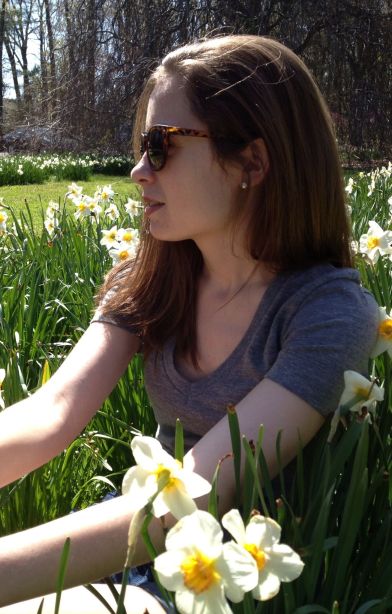
Our foray into the wild came to a close, though, when we’d lapped the same young family three times on the nature trail and filled our iPhones with daffodil photos.
Also, I had some returns to Banana and H&M that needed to be taken care of.
Later that night I told my family how much I had enjoyed the wildlife center, that maybe I should do things like that more often. It’s a good way to slow down, enjoy the weekend, and get away from the rush of the city.
“You should have come to the zoo with us, then. You should have run for the elephants.”
“Well, I wouldn’t go that far…”
I guess I put ideas in their heads, though, because tonight my sister approached me with another question.
“Are you going to do the run with us in October? I’m pretty sure there’s another Run For The Wild at the aquarium in Coney Island.”
A run for aquatic elephants?
Maybe, just maybe, I’ll consider it.
ARTIST SPOTLIGHT: Enoch Wu
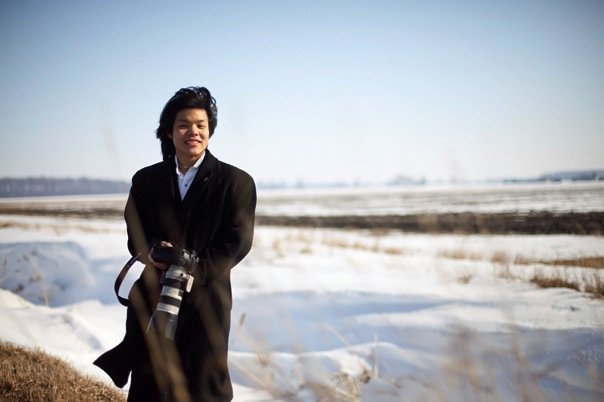
Enoch and I met two summers ago while I was interning as a reporter for The Toledo Blade. He is a photojournalist for the nearby Bowling Green Sentinel-Tribune, and we ended up on the same assignment out on an airport runway in Millbury, Ohio. I noticed he was holding an iPad (back then they still seemed pretty scarce!) so while waiting for our interviews and photo opportunities we began discussing technology and the future of journalism.
Enoch is a talented photographer who is also technologically savvy. He says his interest in technology goes back to childhood, when he was exposed to computers at an early age and “always had a sense to tinker [with] things and break things.” When he used a computer, Enoch said, he would dig into the software to see what he could change or manipulate. As a child, he even mischievously figured out how to subscribe to PCWorld Magazine and have it charged to his parents’ credit card. Today, his morning ritual includes keeping up-to-date with the industry by checking various photography and technology sites.
In addition to his work for the Sentinel-Tribune, Enoch shoots event photography for Toledo.com. He is also a freelance wedding and portrait photographer. For Enoch, whose primary passion was music before college, photojournalism is more than the act of capturing a moment with a camera.
It’s about telling a story through an image.
“Henri Cartier-Besson, the father of photojournalism said it the best: ‘Photography is nothing — it’s life that interests me,’” Enoch said.
Here are the highlights from my Q & A session with Enoch, including some of his work from the Sentinel-Tribune. And make sure to check out more of his photography at enochwu.net!

SF: We’ve all heard the common expression, “A picture is worth a thousand words.” To what extent do you agree with that? What do you think a photo can portray that a written story cannot?
EW: I tend to think that in today’s world, with technology and mobile phones, a picture has become a commodity and there is not enough emphasis put into making a photo worth a thousand words. The process is so instantaneous that people don’t think about how and what they are photographing—a proper photo is worth a thousand words.
It’s hard for me to say what a photo can portray that a written story cannot. Both photos and stories can evoke emotion and thought; both can open doors to new ideas and take people to new worlds. I’d say the main difference is that in reading, people must imagine a scene and a moment, whereas with a photo, that information is provided in a condensed visual form and does not require as much imagination.
SF: Who are some interesting people you’ve gotten to photograph or work with through your job?
EW: Oh, there are so many interesting people with interesting stories. Perhaps too many. [Recently] I photographed a smart 10-year-old, deemed the youngest developer with an app in the Apple App Store. It was exciting for me to see such a young “geek” doing something cool. It was also exciting to associate a little one with technical jargon and to see the wonderful support of his father, who is an intellectual property lawyer. What a perfect team.

SF: Dream subject to photograph?
EW: I don’t “dream” to shoot anyone since I believe that it’s about my subjects, I care more to hear their story and to photograph them the best way to tell their story. My subjects are on level ground, whether it is a three-year-old or the president of the United States.
But now that I think of it, it would be interesting to photograph Paypal/SpaceX/Tesla founder Elon Musk, or Jonathan Ive, the lead designer at Apple. There are musicians, too—it would be interesting to shoot Andrea Bocelli, the blind Italian classical artist, or Regina Spektor, Fiona Apple, or Björk, for that matter.

SF: Clearly, the newspaper industry is in a state of rapid change, and must transform drastically to survive. If you had the power to revolutionize the industry, offering different forms of digital content, what would you do?
EW: I would use my entrepreneurship knowledge to find a way to raise the bar for journalism once again, to bring long-form journalism back and to draw people to enjoy reading again. Some of us still love reading, but I have a sense that it can be made enjoyable for those who may not necessarily enjoy it at the moment, and for those who are glued to the television.
In my work, quality is key, and I stand firm in the matter that my work should speak for itself. Therefore, I would expect the same had I the power to “revolutionize” the industry.
It’s more complicated than just digital content and pay walls. We need to reevaluate newspaper business models and practices that rely on a world when print journalism was at its peak. We need to bring the right people in—visionaries who are concerned about the future of editors, journalists, photojournalists and other newspaper staff rather than people [only] concerned primarily about monetary gains, finding Band-Aids to put off bankruptcy. We need to include people who look at the web seriously in all aspects: security, intellectual property, design and digital content, of course.
Solutions must be concrete, not half-baked ideas that fail. This is no time for failure as the jobs of so many great newspaper staffers are at risk. The medium of written journalism and the importance of reading are at stake, too. Written journalism is an imperative part of our future—our democracy and its success depend on it.
SF. What are your goals for the future?
EW: Right now I’m taking life as it goes—taking advantage of my full-time position at the paper and freelance jobs in Northwest Ohio, with the goal of building my ideal collection of gear and continuing to meet new people and create connections.
One of my personal goals is to return to music with a greater passion towards it. My standing long-term goal, lets say a period of five years, is to utilize my entrepreneurial sense to develop something that will secure my future as a photojournalist as well as the future of many other newspaper staffers. I’ve always wanted to run my own design firm too, but that is a tabled goal until the ones above come to fruition.
SF: Interesting fact about yourself?
EW: I secretly aspire to be Steve Jobs, to change the world…and photography is a cover.
*This interview was condensed and edited.
Header photo: Copyright © 2012 Bowling Green Sentinel-Tribune. All rights reserved.
One of my favorites.

Metropolitan Diary: A Silhouette in the Rain

Exciting news- a story and photo of mine, about a fleeting moment I experienced in New York City one night, were published today on the NYTimes.com Metropolitan Diary page! (Check out the article here or click the image above.)
The Metropolitan Diary has existed for over 30 years as a place for New Yorkers to share odd or inspiring moments. Recently, the collective diary has taken to the online sphere, and one entry is published each weekday on The Times’ website. For those still in favor of the printed word, some entries appear in the newspaper on Mondays.
In the old days, according to the site, the Diary mailbag weighed 20 pounds, and published contributors were rewarded with a champagne delivery.
While storytellers no longer receive champagne, “today’s reward is a bylined entry into New York’s story canon, an ingredient of ‘this elegant cocktail of the city.'”
I’ll take that.
Irish Boys of Brooklyn: New Year’s Eve 1973
Author’s Note: This article was first published in Notre Dame Magazine at magazine.nd.edu.
***
All night, off in an alcove behind their simple makeshift bar, Pelan and Kelly poured foaming pitchers of Budweiser and stirred up the occasional whiskey and ginger ale. A radio in the corner spouted updates from the Notre Dame-Alabama national championship game.
Beyond the alcove, men in suits with skinny ties and women with beehive hairstyles danced the waltz and fox trot to a live band.
It was the final night of 1973. About 200 gathered in the auditorium of Notre Dame Parish in New Hyde Park, Long Island, for the annual New Year’s Eve dance. Among the revelers were my grandfather, Patrick Coyne, and my grandmother, Dorothy.
Friends crowded around tables for 10; plastic cups quickly emptied. Men were making regular jaunts back to that little alcove to refill pitchers for their group.
Regular jaunts, of course, to the radio at the bar.
“Wives would be wondering, ‘What’s taking the hubby so long to get a pitcher of beer?’” my grandfather said. “But it was kind of exciting times, and you couldn’t walk away.”
As the time till midnight grew shorter, the beer runs grew longer. Every man wanted an excuse to slip into the little alcove and catch the latest on the game. And as the game moved into the fourth quarter, they lingered longer, crowding around that radio the way they might crowd around a campfire.
“Then it went down to 24-23 [Notre Dame], and Alabama had the ball now with only like a minute and 48 seconds left,” Papa said. “But that could take a lifetime to play.”
Within the parish, alliances to Our Lady’s university ran deep. Most members were first-generation Irish-Americans who had grown up together in immigrant neighborhoods of Brooklyn and Queens.
The majority had not gone to college. Those who did went on the G.I. Bill. To my grandfather’s knowledge, none had gone to Notre Dame.
But since childhood they had idolized the Irish.
 Patrick Coyne, an Irish fan for 70 years, on Notre Dame’s campus for the 2008 game against Stanford
My grandfather was raised in Prospect Heights, Brooklyn, in the 1930s and ’40s, an area teeming with poor Irish, Italian and German immigrants, called the “Ninth Ward” by Brooklynites. His father, a longshoreman, worked hard but sometimes drank even harder.
Despite the crowded apartment, tattered clothes and meager, unstable income, Papa looks back at those years fondly.
Children in the tenement had few possessions but vast, sprawling imaginations. For the tenement kids, the streets, the parks, the abandoned lots and the stoops were their kingdom.
Papa remembers waiting on the street corner for the 8 p.m. “bulldog edition” of the Daily News — only 2 cents then — to arrive. He’d flip to the sports section to read about the “Fighting Irish,” the only college football team he and his buddies took interest in.
On Saturdays, Papa and his friends might head to the theater to see a double feature for 25 cents. A newsreel of current events always played between the two films.
“The [newsreel] would have a less-than-a-minute snippet of the Notre Dame game,” Papa said. “That’s all we waited for, that was the whole thing for us.”
The boys took their love for the Irish out of the theaters and into the streets. But since the movies were in black and white, kids from Papa’s neighborhood never knew what colors Notre Dame really wore.
“When we played organized football we’d call ourselves the ‘Fighting Irish’ and we’d get green and gold uniforms,” Papa said. “When they’d line up behind the center, our quarterback, Marty Dougherty, would say something like ‘down big green and gold!’ Meanwhile, we were these scrawny-looking skinny Irish kids.”
Papa and his friends were just a few of Notre Dame’s poor but passionate “sidewalk alumni.”
Sports journalist Jimmy Cannon also grew up in an immigrant neighborhood of New York City. In a 1967 column for the Daily News, he writes about the pride that bonded the Irish slums of New York to an affluent university over 700 miles away.
Like movie stars, Cannon says, Notre Dame players were revered from afar.
“Football was important. But Notre Dame was a cherished symbol,” he writes. “In our neighborhood, where a good education meant graduating from grammar school, the Notre Dame football players were the perfection of our kind.”
“On our mean streets, no band played and a pennant never waved when Notre Dame won,” Cannon writes. “But we were as much a part of that distant university on the prairie as though we had a diploma to prove it.”
As a child, my grandfather barely crossed the boundaries of New York City. So for all he and his buddies knew, South Bend, Indiana, could have been a landlocked Emerald Isle.
Perhaps Notre Dame’s remoteness made it even more captivating.
As the boys of Brooklyn built their careers and rose into the middle class, they moved east into modest homes on Long Island but have remained close friends for over 70 years.
Hugh Mullin, one of those friends, broke the good news about the championship outcome that New Year’s Eve of 1973. He had disappeared back with John Pelan and Harold Kelly — much to his wife Mary’s chagrin — and wasn’t seen again until around 11 p.m.
“Hughie came running back, yelling, ‘They won, they won, they won, they beat Alabama!’” my grandfather said. “He was jumping up and down, and then everybody was jumping up and down.”
Even the previously irritated wives joined in on the excitement. The band played The Victory March.
“The revelers went crazy with joy,” Papa said. “The real party had begun in earnest.”
When 1974 arrived at midnight, the bittersweet words of “Auld Lang Syne” soared through the auditorium and couples swayed in beer-fogged bliss.
“But needless to say, the ringing in of the New Year was a bit anticlimactic,” Papa said. “By the time 12 o’clock rolled around, we had already done all our [real] celebrating.”
Thirty-nine years will have passed when Notre Dame faces Alabama again in another high-profile matchup for the national title. Since then, Papa has had a son and a granddaughter graduate from Notre Dame. He has visited campus countless times with his buddies from Brooklyn, watched it blossom beyond the original quads. He’s discovered South Bend is a second home for the Irish but no replica of the Emerald Isle.
For my grandfather, he certainly won’t be in a church gymnasium this time around with the Crimson Tide.
“Before, I could go to the dance,” he said, laughing at the absurdity of listening to the game on a bar radio. “Now, I couldn’t go to a dance. No way.”
10 Essential Tools for the Modern Writer

Laptop. Coffee. Water. All a writer needs for a long day of creative composition, right?
Sitting in my favorite Cool Beans today, I thought about the most important things for my productivity as a writer. I’ve been writing creatively, almost innately, since I was very young, but I realized I needed these “tools” when I began thinking of writing as a craft or a profession.
Essential tools in my writer’s toolbox (besides coffee, water and laptop)
1. Books: It doesn’t matter whether they’re digital or print. Reading is absolutely vital for good writing. A writer who doesn’t read is like a musician who doesn’t practice or an athlete who doesn’t train. There is almost no chance for growth.
2. Internet: Maybe there was a day, way back in 1990, when access to the Internet wasn’t important for the modern writer. Nowadays, I get significant inspiration from flipping through random writing blogs, The New Yorker fiction archives, magazines and online newspapers. That being said, the Internet can sometimes be detrimental to the writing process. Author Zadie Smith suggests working on a computer that’s disconnected to the Internet. I don’t totally agree, but when it’s time to get down to the really hard stuff, the Internet can be counterproductive.
3. Coffee shops: For me, coffee shops make the perfect environment for writing. I need the stimulation of conversation and buzzing espresso machines. I also need a place that’s quiet enough for me to isolate myself with headphones.
4. Notepad. Again, whether it’s an iPhone or a Moleskin, that doesn’t matter. What does matter is that I always something on hand to jot down ideas or paragraphs when the muse strikes.
5. Thesaurus. Let’s face it: no writer always has the perfect word to describe their perfect image. The thesaurus is a fabulous writer’s tool for constructing with words the image already constructed in your mind.
7. Music. The way runners have pump-up playlists, most writers use a playlist of songs to help them transition into a writing mood. Sometimes it’s very difficult to go from the mindset of rushed every day life to the very patient, isolated and introverted mindset of writing. Music is also one of the best tools for climbing out of the trenches of writer’s block.
–> What are your essential writing tools?
Yes please. (Si, por favor.)
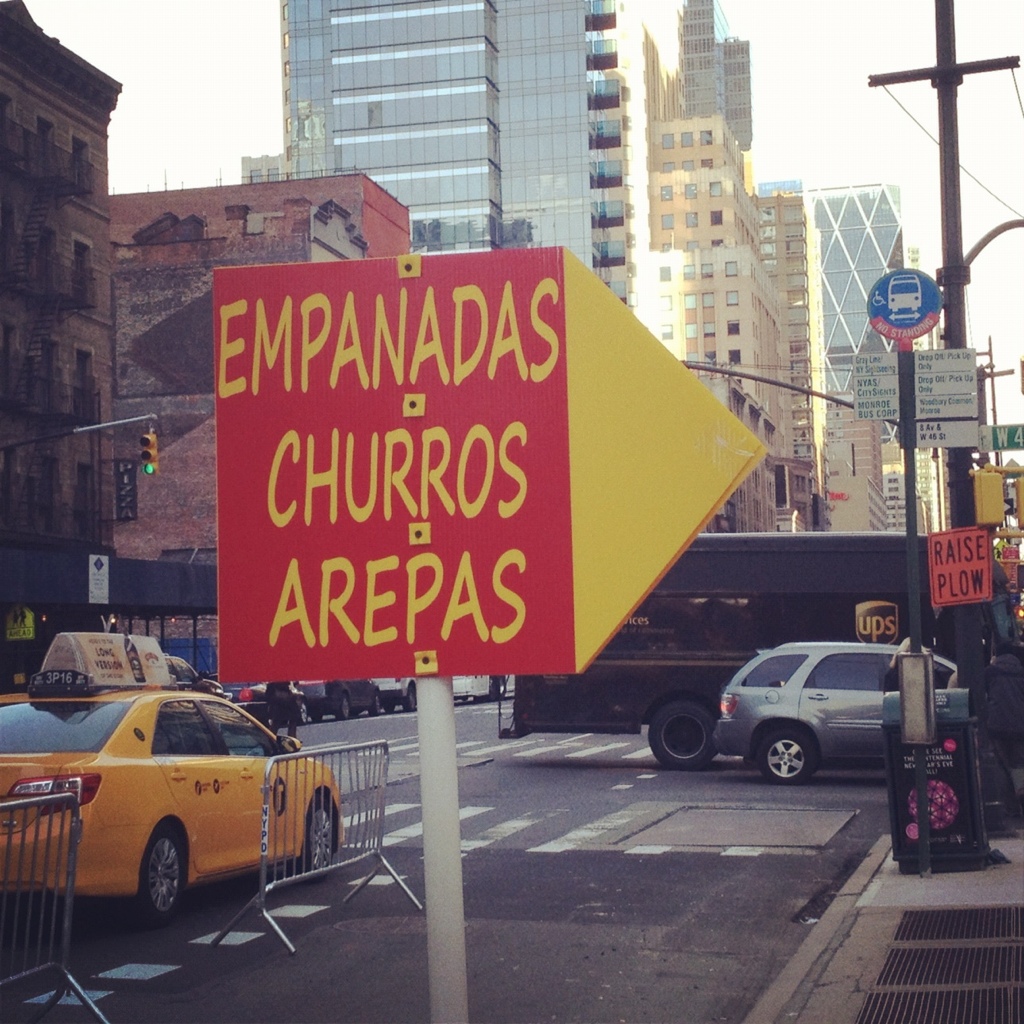
Eighth Avenue and 46th street, New York City.
Musings on writing, design & NYC
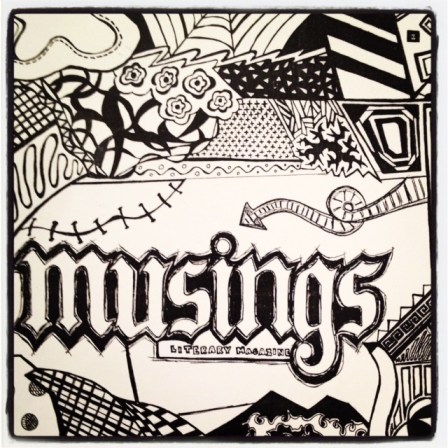
I’ve known my blog needed a tagline for some time. It took me almost a year to come up with the name “Sketching A Story,” but a name isn’t necessarily enough for readers to make that immediate connection with what the blog is about. Yes, okay, I have “story” is in the title, but what kind of story? And what does it mean to “sketch” a “story?”
So my tagline has been in the works for the past couple of weeks. First I just scrolled through my posts to get a better sense of what I write about. I know that sounds crazy, but my blog has changed a lot since I started it about a year and half ago and I wanted to reassess where it’s been and where it’s going.
I write about writing– that’s an obvious one and pretty much the core focus of my site. I write about New York City. I write about college and Notre Dame. I write about being a recent college grad. I write about everyday things that inspire me. I write about things that visually intrigue me– I am fascinated by design, whether it be graphic, website or interior design.
In the end, I chose “writing, design & NYC” to be the three umbrella categories in my tagline. Now how to link those three words together? I really didn’t want to go with “thoughts.” So many blogs use the phrases “thoughts on life” or “random thoughts,” which say almost nothing about the blog’s focus. Then I remembered my high school literary magazine, Musings, which I worked on for four years. (I dug up a 2006 copy for the photo above.) “Musings” was perfect. Not much more specific than “thoughts,” but I like to think it’s more literary 🙂
So there it is: Sketching A Story: musings on writing, design & NYC. Nothing revolutionary, but it’s simple and I like it.
Have you ever struggled to define or brand your blog?
Jumpstart the thought process…

I hate the word “flow,” I really do. But sometimes when you follow the above advice, the words just flow onto the page. There’s a good chance you’ll delete most of those words later on, but you’re in a much better position than simply staring at the screen, trying to force a vision that won’t come.
 SKETCHING A STORY