
“Bookfessions”
I stumbled across this Tumblr during my daily traversing through the Internet, and was caught by the bright colors and the interesting blog title, “Bookfessions.” I love blogs that combine good, simple design with a really clear purpose. This blog is all about “confessions and/or thoughts of a book lover, bibliophile, book addict, reader, lover of literature, nerd.” The author also accepts submissions from readers.
Below are a few of the “bookfessions” I can particularly relate to. Which are your favorite?


Top 10 things that make me happy (in no particular order)

1. Cities
2. Being with friends and family
3. The first spark of a new idea
4. A good book
5. A warm, bold cup of coffee in a ceramic mug
6. Running in cool mist in early fall
7. Delicious, spicy Mediterranean food
8. Finding interest in a brand new thing
9. A bottle of wine and great company to share it with
10. Interviewing someone who’s unexpectedly inspiring
A bit of Monday optimism…
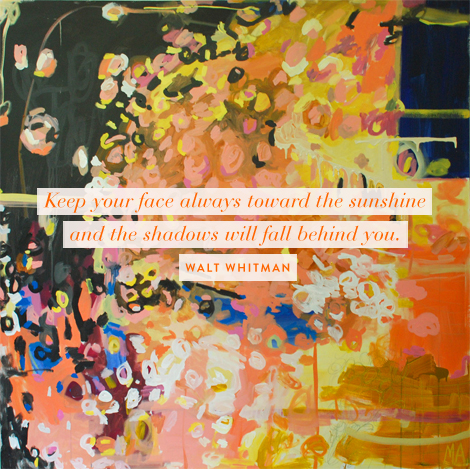
A Fiction Writer’s Manifesto

Fiction is both a personal form of expression and way of commenting on events that affect the population at large. Fiction should strive for beauty because it can — so many other forms of writing do not offer that freedom. My fiction writing is not rebellious nor is it experimental but it is definitely influenced by the fast-paced writing forms of the online world.
My work makes use of two opposing writing styles and constantly displays a tension between them: the succinct phrases characteristic of journalistic writing and the metaphoric imagery characteristic of poetry. I like to approach fiction methodically — as I would in journalism, but with feeling — as I would in poetry. My fiction is based off these two types of writing, yet falls somewhere in between them.
When composing fiction, I strive for five main characteristics:
- The beauty of the written word: Fiction is an art form, so I want my words to sound beautiful, regardless of the subject matter. Using words with a history of alternate meanings — and being conscious of those alternate meanings — can help deepen the implications of a story. Words in fiction should sound beautiful together despite the content or subject matter. However, the definition of “beautiful” can vary depending on the story. That being said, images should not be beautiful simply for the sake of being beautiful; they should also play a larger role in the storyline.
- Economy of language: This characteristic fits hand in hand with the previous one. I believe simplicity of language adds to a story’s beauty — the simpler something is conveyed, the more emotionally resonant it is. Portraying beautiful images in minimal words is extremely difficult to do, and is a great accomplishment when it is achieved.
- Engagement in current events: I tend to write fiction that is, naturally, influenced by the events going on around me. I also intentionally create fiction that comments in some way on a relevant societal issue. I’m careful to make that issue a central motif without explicitly stating it. Building up the tension of a problem without outwardly addressing it creates a foreboding tone; not saying something outright can make its presence in fiction even stronger.
- Focus on realism: I almost always write in the realist style. I’m not comfortable writing in genres like fantasy or scientific fiction, but those genres also aren’t conducive to the goal I have to shed light on issues that might be otherwise brushed over. My stories tend to begin quite ominously but in familiar and typically comfortable settings — I want the reader to feel uncomfortable from the beginning without knowing why. Then, slowly, small details are dropped so that discomfort deepens. Through a focus on realism, I try to address topics that might be painful or taboo in casual conversation.
- Multiple narrative planes: I envision my writing as moving in several directions at once, all convening somehow in the ending. My goal is to set up these different narrative planes early on in the text, but write with enough authority that the reader is convinced each has its own purpose. Sometimes these layers are created by integrating different kinds of writing, including poetry, journalism and essays, into the fiction itself. The various layers also help create endings that are somewhat ambiguous but still convey a specific feeling.
My writing is generally traditional. I love writing in the vignette style in particular because it allows me to incorporate poetic phrases naturally into fiction. Vignettes give me the opportunity both to create the beauty that I strive for and to comment on a single issue from a number of different perspectives.
As a young writer, social media and online writing inevitably influence my work, since those are things I engage with on a daily basis. Despite most forms of writing being in a state of such rapid change, however, I believe traditional, printed fiction continues to be crucial today. The mind processes ideas differently when work is read on the printed page versus when it is read on a screen, so the printed page is necessary even as the world of digitally published fiction expands. A goal for my future work is to reconcile these two sides of fiction, always keeping in mind how a story will be interpreted differently depending on whether it’s displayed on a digital or traditional background.
Let’s Bring Back: The Cocktail Edition
Remember this post?
(Actually, I’ll be seriously impressed if you do.) “Classics & Cocktails” was one of my first, written shortly after I turned 21 in Toledo, Ohio last summer. I was bored and lonely in my apartment one day, flipping through some classic literature I’d taken out of the library. I felt like going out, but my fellow interns were working the night shift (we often had opposite schedules) and I had no one to have a drink with.
So naturally, I decided to Google my favorite authors’ favorite drinks and write a post about it.
Classic literature and classic cocktails: what a perfect combination.
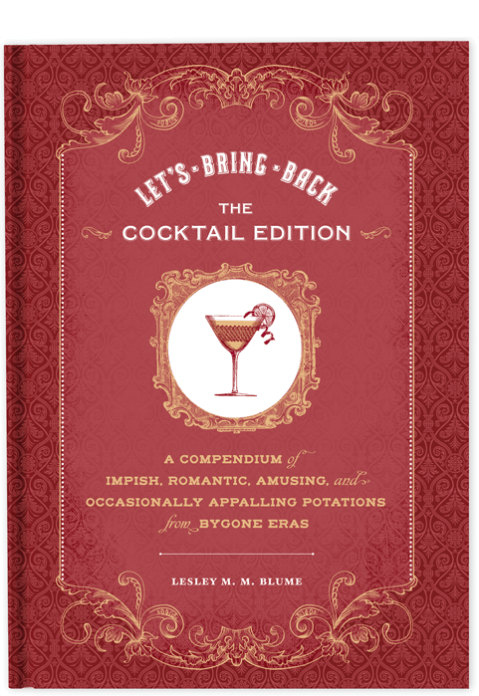
Well over a year later, at a book sale at work the other week, I found this gem. Let’s Bring Back: The Cocktail Edition by Lesley M. M. Blume, a journalist and author based in New York City. The cover drew me in initially (isn’t it preettyy?) but the content pushed me to buy it. It’s basically an entire book of classic cocktail recipes, along with humorous anecdotes about each one, bits of history, quotes and poems.
The Chicago Tribune called it “a charming slip of a book…that quite deliciously and convincingly has the romantics among us pining for the ways of the dearly held past.”
Definitely my kind of thing.
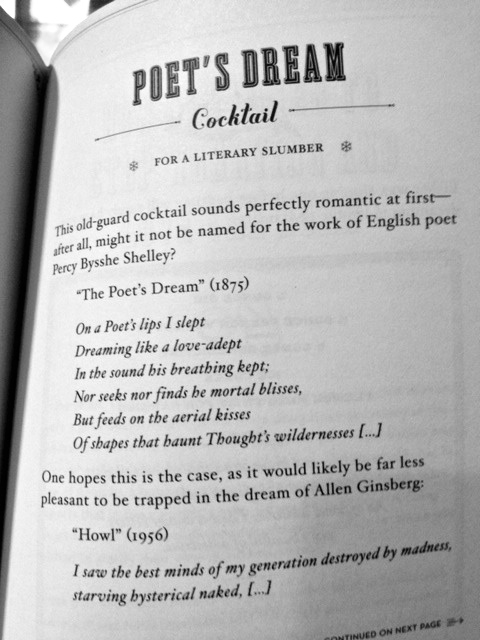
In Ms. Blume’s introduction to the book, she writes:
“It’s great fun not only to revisit the stories behind the creation of these cocktails, but also to imagine the millions of narratives caused by drinking them. The following libations caused faces to be slapped, tears to be shed, babies to be made, fox trots and the Twist to be danced, marriage proposals to be uttered (and perhaps rescinded,) and so on.”
She continues, more seriously:
“The people who drank these drinks during the heights of their popularity did so for the same reasons we guzzle today’s trendy cocktails: to celebrate, to escape, to drown sorrows, to feel bigger, to feel glamorous–or feel nothing at all.”
As tongue in cheek as most of the book is, it also touches on the deeper theme of why people drink, why socializing over alcohol has persisted so strongly throughout history.
For now, Let’s Bring Back: The Cocktail Edition is tucked neatly into my bookshelf. But as soon as I have my own apartment in a city, I’m going to make use of this book and hold an epic throwback cocktail party, unapologetically artsy and decidedly literary.
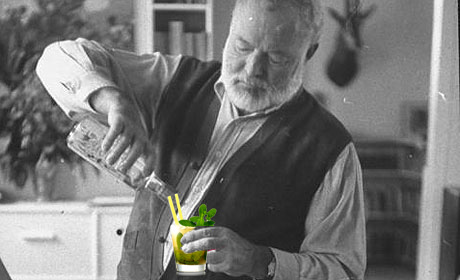
Either that, or I’ll go find a way back to go back to the grandeur of 20s nightlife, Owen Wilson style.
Fictional Cheers, Hemingway.
ND. UM. ’08. Let’s bring this back.
On the bus home from work this evening, I checked the weather for South Bend and was bummed to find a 50 percent chance of rain forecast for Saturday.

Rain during the 24 hours I’ll be on campus, during the one ND tailgating experience I’ll have until next year, during the one home game I’ll be at this fall after attending all 26 over the past four years? I wasn’t thrilled, to say the least.
But then I thought: let’s bring this back.

The mud, the wet, the win. Let’s bring ’08 back like we never graduated.
Saturday calls for some mucky, mucky Fichigan.

First class seating for bookworms

Notre Dame admissions video: Any Given Day
“It’s about shaping you as a person and really getting you prepared for your life after Notre Dame.”
As a junior in high school, I found college touring exhausting. All of the info sessions, tours, scheduled meetings with student representatives– they all blended into one another. I had trouble defining what schools were really like when almost all the admissions literature teemed with vague words like “history,” “tradition,” “opportunity” and “success.” I can’t tell you how many schools I looked into that boasted “completely unique” opportunities for me. Was that even possible? How was I supposed to decide the location of my next four years, and the foundation of the rest of my life, based on a “gut feeling,” a programmed tour of interesting facts and some carefully worded handouts?
Since going to Notre Dame, I’ve always thought the only way to really know a school, to understand what it’s all about, is to be there as a student. Yes, there’s that feeling you get when you first walk on campus as a prospy, when you realize you “know” the school on some basic level. But that feeling grows, changes and transforms when on campus for good. When you discover the major you didn’t know existed or the club you dedicate all your free time to, that feeling seeps into deeper parts of you. It’s no longer a fleeting emotion awakened only when looking up at the Golden Dome for the first time, but something more permanent, cultivated by the things you do on campus and manifested in the relationships you make.
Unfortunately, the wrapped-up-with-a-bow perspective typically handed to prospective students by the admissions office does not and cannot portray what a school is all about. The scope of the student experience– what’s possible over four years– is much too large.
But this new video released this week by the Notre Dame admissions office is different. The video was produced by Philadelphia-based Neighborhood Film Co., a company that “mentors and employs individuals recovering from homelessnesss, mental-illness or addictions through the process of filmmaking.” Not only is it a fresh, modern and interesting work of videography, it both accurately and beautifully portrays the character of the University. Unlike videos I’ve seen in the past, I can’t pass this off as an annoying, overdramatic compilation of clips used by admissions to either play up or play down various aspects of Notre Dame.
Because it doesn’t. It’s not. It’s kind of the real thing.
Watch it.
Hemingway on writing
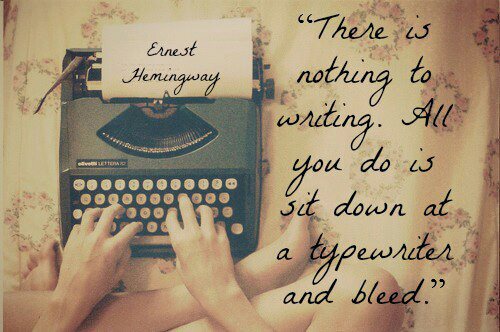
Is this real life? That’s exactly what it is.
Classes commenced at Notre Dame last Tuesday, and the first “official” week begins tomorrow. For the first time in four years, I won’t be going back. It’s a strange feeling, knowing that life at ND goes on without me or the other 2,000 plus members of the Class of 2012 that ate, studied, hung out, played sports, performed, chatted, made friends, made trouble and infinite other things within the boundaries of campus since 2008. Thinking about campus, classes and parties, I feel pangs of sadness and nostalgia for those wonderful years I know I’ll never get back. But I am excited and ready for the next phase, which Notre Dame prepared me well for.
Throughout college, whether referring to being abroad, acing a test not studied for, talking to the crush we thought was totally out of our league, we’d throw around the phrase, “Is this real life?!”
Now, the Class of 2012 is finding out its true meaning.


Brilliant August Sun
Few things can shake the monotony of commuting, or the feeling that whether on a bus, train, subway or in a pack of people hustling at 8:50 a.m. towards Midtown, as a commuter you’re “one of many.”
It may seem obvious, but once you start commuting you become “a commuter.” Above all else. You’re one of thousands, hundreds of thousands, and in this city, millions. To strangers on the street outside the bus terminal, who see your suit before your face, “commuter” is your principal identity.
Each day I catch the bus, go to work, catch the bus, come home. Sometimes the rides are short and sweet and sometimes they’re long and painful — bumper-to-bumper traffic — filled with passengers either asleep from exhaustion or mumbling profanities under his or her breath.
That’s commuting. Sometimes you’re lucky, sometimes not. That’s just the way it is.
Coming home, I get off the bus at a stop on the edge of the highway. I walk about 50 yards in dusty dirt and grass before climbing the steps to an overpass that takes me across the road, and finally, to the parking lot where my car waits.
It’s repetitive. Wearisome. Crossing and re-crossing your tracks each day, you get that uncomfortable déjà vu feeling you know isn’t really déjà vu. Usually I rush up and over the steps, walking as fast as my worn out feet will allow, shamelessly showing off my endurance to fellow commuters.
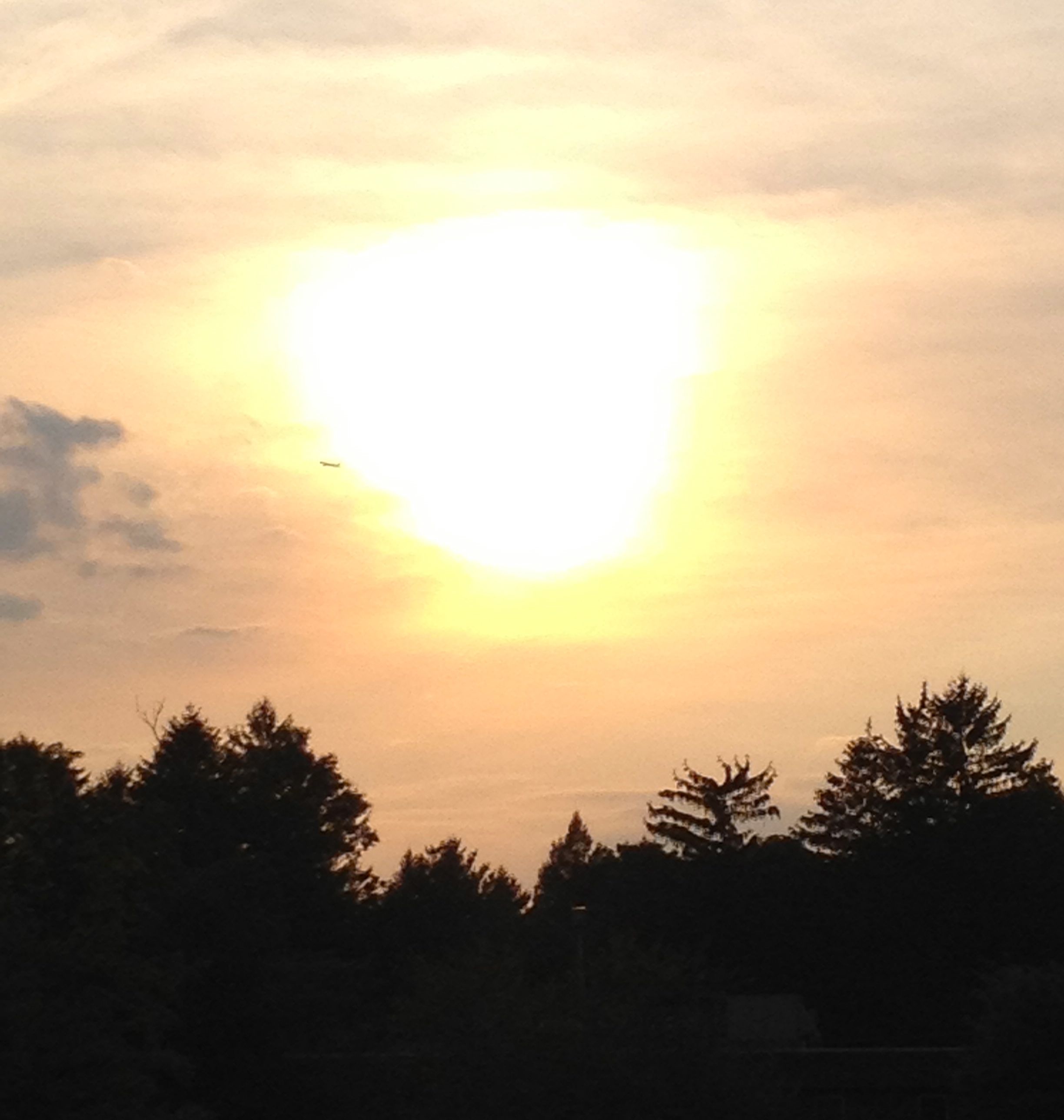
But lately, as I’ve reached the height of the overpass, I’ve been greeted by this brilliant August sun — so rich and bold it makes me stop in my tracks.


Commuters in the single file line behind me don’t know why I stop. They don’t see the sun the way I do — they only see straight ahead. Doesn’t she have somewhere to be? What’s she doing? Why is she lingering up here? The stares are audible.
But they stare only briefly and then continue on, to the wide spectrum of people they have to meet, places they need to be. I lean against the crosslink fence, looking down at the traffic and then up again at the sun. The timing is perfect: 6:45 p.m. I check my phone. The sun sets at 7:44.
It’s not just the colors that strike me, but the intensity of the light, spreading through the sky, slowly but inevitably like water on a flat surface. A plane appears miniscule the moment it passes through the growing, dying light. Pine trees in the distance become charcoal-black silhouettes against the sun’s aggressive glare.
I’ve arrived home right at that wonderful, extended dusk period so characteristic of late summer. The colors I think of when I think of August — deep pinks, reds, yellows and greys — all of those colors are here.
I’ve got one month. By Wednesday, September 26, the sun will have completely set by the time the bus doors creak open and I exit into suburbia. And until December 21, I’ll be riding that bus into an increasing shade of darkness.
I keep leaning against the railing until the next round of commuters starts moving up and over the overpass.
I’ve got one month, and less time each day.
I shuffle down the stairs, get in my car. I feel good. Relaxed. Like I have something, know something, that separates me from the masses of people moving in and out of the city each day. Like for a moment, I stepped off the beat we’re all so devoted to, and didn’t lose a thing.
I’m tempted to keep watching the sun as I drive, but instead let it soak into my skin, spill through the slits of the open windows.
 SKETCHING A STORY